
Dead Heat Rules in Horse Racing: How Two Horses Splitting a Place Splits Your Stake
 Available in US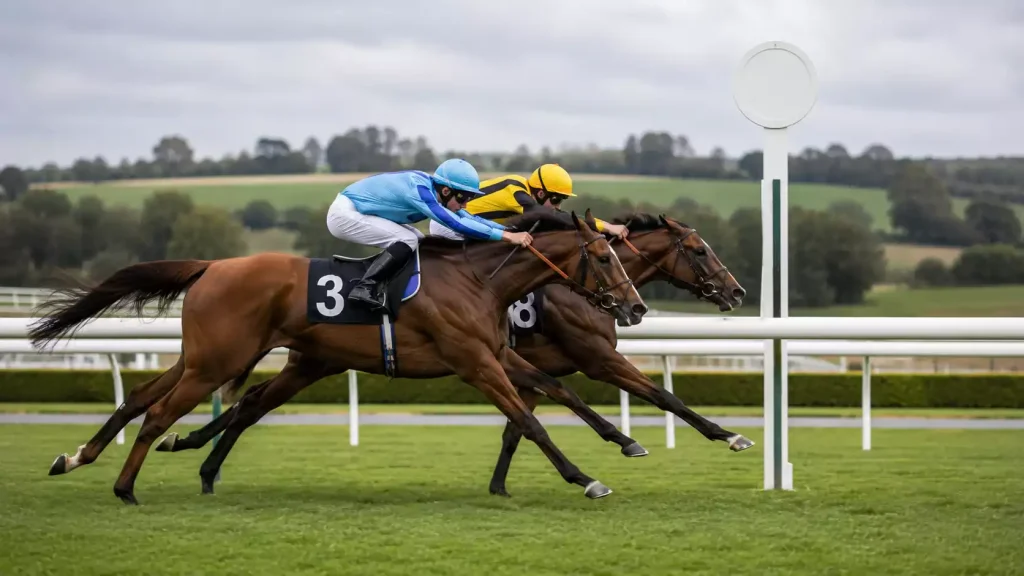
When Two Horses Cross Together and Your Slip Goes Strange
It happened to me in 2021 at Goodwood. The horse I had backed each-way finished a clear third – except the official result, called eight minutes after the race, gave him equal third with another runner. The judges had spent those eight minutes peering at a photograph. My slip, which I had assumed was a clean place hit, suddenly became a “dead heat” settlement, and my return was exactly half what I had been mentally banking on the walk back to the car park.
A dead heat is what happens when the official judge – using a photo finish in modern racing – cannot separate two or more horses for a specific finishing position. The judge declares both horses to have finished in that position, and the bookmaker’s settlement rules then apply a halving (or third-ing, on the rare triple dead heat) of either the stake or the odds. The mechanic is industry-standard but the effect on a punter’s pocket is genuinely surprising the first time it happens.
The dead heat rule applies to every kind of bet that involves finishing position – win bets, place bets, each-way slips, forecasts, tricasts. The maths is different for each bet type, but the principle is the same: a tied finish means a shared payout. For UK punters who have never thought through what happens when two horses cross together, the rule is worth understanding before it costs you money.
Dead Heat Rules in Horse Racing — More on this topic at bet to show horse racing .
What a Dead Heat Is in Official Settlement Terms
The dead heat is an official racing concept, not a bookmaker’s invention. When the photo finish camera cannot definitively separate two or more horses for a specific finishing position – typically when the noses are aligned within the resolution of the camera at the wire – the stewards declare the two horses to have finished in the same position. Both are awarded the same official finishing rank, and the position below them is skipped.
The mechanic at the racecourse is simple. If two horses dead-heat for second, the third-placed horse becomes the fourth-placed horse in the official result. There is no third place. The next horse is fourth. The placement table on the racecard advances by the number of horses involved in the dead heat, so a triple dead heat for first means there is no second or third – the next finisher is fourth.
Photo finish resolution has improved enormously over the past three decades. Modern slit cameras at British tracks operate at 2,000 frames per second, which means dead heats are mathematically rarer than they were when manual judging was the norm. They still occur, particularly in tight finishes on the all-weather where horses can come together at the wire from different parts of the track, but the frequency is lower than recreational punters often assume.
The average field size data is relevant here. Average field size on the Flat fell from 9.14 in 2024 to 8.9 in 2025, with the average jumps field falling from 8.49 to 7.84. Smaller fields mean fewer horses contesting the closing stages and slightly fewer opportunities for tight finishes, though the underlying rate of dead heats per race has stayed broadly stable.
The Dead-Heat Mechanic: Half Stake, Full Odds
The settlement rule for a dead heat is straightforward but counter-intuitive on first encounter. The bet is settled as if half the stake had been placed at the full odds, with the other half refunded. The horse is treated as a winner for half the stake; the other half is returned to the punter as if the bet had never been struck.
Worked example. A £20 win bet at 5/1 on a horse that dead-heats for first place. The dead heat rule treats this as a £10 winning bet at 5/1 – return of £60 (£50 profit plus £10 stake) – plus a £10 stake refund. Total return: £70. The punter has received less than a clean win (which would have paid £120) but more than a clean loss (which would have paid £0). The structure compensates for the shared finishing position.
The same rule applies to place bets. A £10 place bet on a horse that dead-heats for the third position (in a three-places-paid race) settles as a £5 winning place bet plus a £5 stake refund. If the place portion was returning at 2/1, the return would be £15 (£10 profit on the £5 effective stake plus the £5 stake back) plus the £5 refund – total £20, profit £10 on the original £10 outlay.
The triple dead heat – three horses tied for the same position – applies the same logic with a one-third stake division. A £30 bet on a horse that triple-dead-heats settles as a £10 winning bet plus a £20 stake refund. The mechanic scales naturally with the number of tied horses, but the cases involving three or more tied horses are extremely rare in modern racing.
The full-odds element is the part that confuses people. Why “full odds” if “half stake”? Because the operator is paying out as if the horse had won outright on the reduced stake. The reduction is in stake exposure, not in price. The total return is therefore half what it would have been on a clean win, but the prize money per pound of effective stake is identical.
How a Dead Heat Hits the Place Portion of Each-Way
Each-way slips interact with dead heats in two distinct places. If the horse dead-heats for the win, both halves of the slip are affected – the win half settles at half stake / full odds, and the place half settles identically (the horse is a placed finisher by virtue of finishing first). If the horse dead-heats for one of the place positions (second or below) but not for the win, only the place half is affected; the win half is a clean loss.
The structural impact is significant on tight place positions. A horse that dead-heats for the third position in a three-places-paid race – where the third position is the last paid place – sees the place portion of the each-way slip halved. A £10 each-way slip at 8/1 with a 1/5 fraction, on a horse that dead-heats for third with another runner, settles as follows: win half loses (£10 down); place half at 1/5 of 8/1 = 8/5; half stake means £5 at 8/5 returns £8 profit plus £5 stake = £13, plus the £5 refund on the unbet half. Total place return: £18 on the £10 place stake. Net outcome on £20 outlay: £8 profit (down from £15 profit on a clean third).
UK standard place terms – 1-4 runners win only, 5-7 runners pays two places at 1/4, 8 or more non-handicap runners pays three places at 1/5 – directly affect the dead heat impact because the worst-case scenarios are concentrated on the last paid place. A dead heat for second in a three-places race is annoying but not catastrophic; a dead heat for third is more painful because it is the boundary between being paid and not being paid.
The 4-places-at-1/4 bracket on big handicap fields (16-plus runners) produces a slightly different dynamic. A dead heat for fourth – the boundary place – halves the place return, but the fraction is more generous and the win-side likely longer-priced, so the absolute pound impact is less dramatic. The principle holds: dead heats on the boundary place position are where the rule bites hardest.
Triple Dead Heats: Rare but Real
A triple dead heat is the photo-finish equivalent of a lottery win in reverse. Three horses crossing the line in a finish too tight for the camera to separate is mechanically possible but happens perhaps once or twice a year across the entire British racing programme. The rule that governs the settlement is the same as for a two-horse dead heat – stake divided by the number of tied horses, full odds on the reduced stake – and the impact on a place slip is correspondingly larger.
The most-discussed modern triple dead heat in British racing was the 2007 Newbury maiden where three horses crossed together for first, though similar events occur sporadically across the year on all-weather tracks where the photo-finish resolution sometimes produces tighter results than turf racing. The 2026 Grand National field maximum has been reduced from 40 to 34 runners as part of Aintree safety reforms – a smaller field reduces the absolute number of tight-finish moments on that specific race, though the rule itself is unchanged.
The strategic implication for punters is minimal. Triple dead heats are too rare to plan for, and any strategy that accounts for them is over-engineered. The right response is to be aware that the rule exists, understand the maths if it ever applies to your slip, and move on.
See also Rule 4 Deductions .
Where 2025 Field Sizes Make Dead Heats More Likely
The field size trend in British racing – flat fields falling from 9.14 to 8.9, jumps fields falling from 8.49 to 7.84 – has a subtle effect on dead heat frequency. Smaller fields mean fewer horses contesting the placed positions, which marginally reduces the probability of a tight three-way finish. But smaller fields also mean more compact run-ins, and the absolute number of dead heats per race has stayed broadly stable.
Where field-size trends matter more is on the boundary places. With more races sitting at 8-runner fields (the threshold for three places at 1/5) and 12-runner fields (the threshold for the enhanced handicap fraction), small numerical shifts in field size produce larger swings in place-terms application. A horse that dead-heats for “third place” in a 7-runner race is not paid at all under the 2-places-at-1/4 rule, whereas the same finish in an 8-runner race pays out (at half stake) under the 3-places-at-1/5 structure.
The interaction with non-runners adds another layer. A 9-runner non-handicap with two late withdrawals becomes a 7-runner race for place-terms purposes, shifting from three places to two places. A horse that finishes third under the original 9-runner terms would have been paid; under the revised 7-runner terms, only the first two are paid, so a third-place finish – including a dead heat for third – returns nothing on the place portion. The operator’s grandfathering rules for bets struck before the withdrawal determine whether the punter gets the benefit of the original three-place structure, and the other half of the late-withdrawal story sits in the Rule 4 deduction scale.
Frequently Asked Questions
Is the dead-heat rule the same at the Tote as with a fixed-odds bookmaker?
Functionally yes, though the mechanic differs slightly. Fixed-odds bookmakers apply the half-stake / full-odds rule on settlement. The Tote applies the dead heat at the dividend calculation stage, splitting the relevant share of the pool between the tied horses' backers. The end result for the punter is mathematically similar: a roughly halved return on a dead-heat-tied finish.
Does a dead heat for fourth in a 3-places race pay anything at all?
No. A dead heat for fourth in a three-places-paid race is below the paid positions and returns nothing on the place portion. The dead heat rule only applies to tied finishes within the paid places. A horse finishing equal fourth where only three places are paid loses the place half of an each-way slip in the same way as any other unplaced runner.
Guides
Forecast and Tricast in the UK: Picking the Top of the Photo Finish
Picking the Order Where Show Bets Stop Being Useful The first Tricast I ever landed was at Pontefract on a wet Wednesday afternoon in 2014. £1 stake, three horses in…
Non-Runner No Bet: The Safety Net on Early Markets, Explained
The Three-Letter Acronym That Saves Ante-Post Punters The Wednesday before the 2024…
How to Read a UK Racecard: The Strip of Numbers That Decides Your Slip
Decoding a Racecard in Three Minutes Flat My father taught me to…
Setting Limits Before You Bet: The Practical Account-Control Walkthrough
The Five-Minute Setup That Outperforms Willpower The most useful five minutes I…
Placepot, Jackpot and Quadpot: The British Tote's Multi-Leg Family
The One Pool Game British Punters Still Reach For The Placepot has…
