
Show Bet vs Place Bet: Two Words, Two Continents, One Big Source of Confusion
 Available in US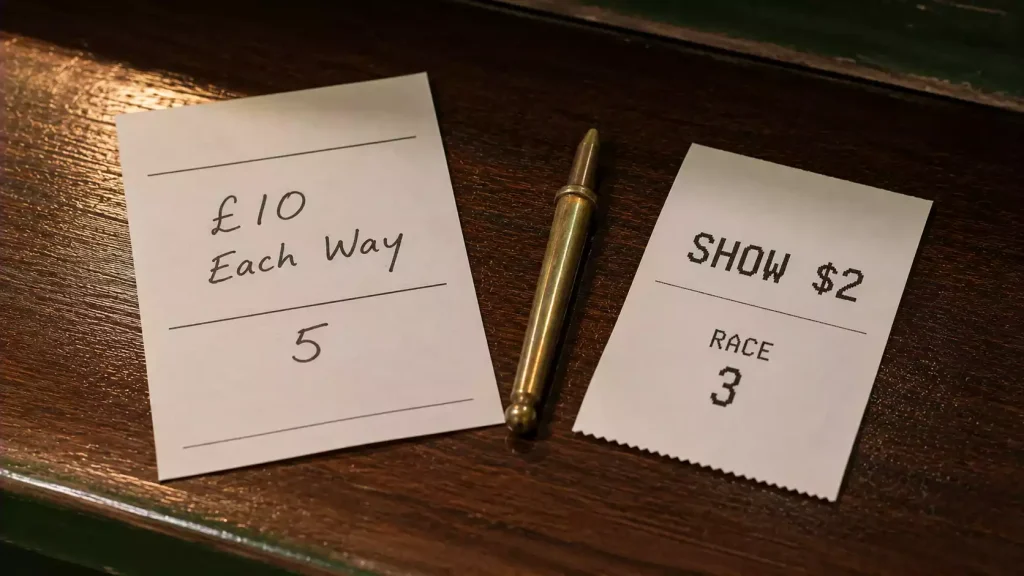
The Sentence That Trips Up Every Transatlantic Punter
The first time a friend visiting from Kentucky stood next to me at Newmarket and asked the on-course bookmaker for “ten pounds on the four to show”, the bookmaker blinked twice, took the tenner, and wrote out a £10 win single on horse number four. Nobody was being dishonest. Nobody was being clever. The two men were simply speaking different languages on the same patch of grass.
That tiny scene is the whole problem with comparing a show bet to a place bet. The words sit close enough in a dictionary that they look interchangeable, and far enough apart in practice that swapping one for the other will cost you money — sometimes a little, sometimes the entire stake. After seven years of writing about UK each-way structures and dipping into North American pools whenever a Breeders’ Cup card looks worth the trouble, I have stopped counting the punters who think these two bets are the same thing under different flags.
They are not. They sit on different payout engines, settle against different finishing positions, and respond to different field-size rules. The American show bet is a parimutuel product. The British place bet — when you can find it as a standalone — is a fixed-odds product. Two engines, two finishing-position rules, two payout philosophies. By the end of this guide, you will know exactly which one belongs on which slip, and you will not hand a fiver to a Newmarket layer expecting Churchill Downs arithmetic in return.
Show Bet vs Place Bet — More on this topic at bet to show horse racing .
Show Bet and Place Bet, Defined Without the Marketing Gloss
Most explainers I read on this topic open with a dictionary entry and then forget to tell you what actually happens at the counter. Let me reverse that order. Here are the two bets stripped of marketing copy and operator spin, as they exist in 2026.
A show bet is a North American product. You place it at an American racetrack — Saratoga, Santa Anita, Churchill Downs, Belmont, anywhere with a totalisator running the pool — and you are betting that your selected horse will finish first, second or third. Three positions, one ticket, one stake. The dividend is calculated after the race from the show pool, after the host racetrack deducts its takeout, and after the remaining money is divided three ways across the holders of tickets on the actual first, second and third finishers. You do not know the payout before the race. You only know it after the last horse crosses the wire.
A place bet, in the British sense, is a fixed-odds product that pays if your horse finishes inside the official “placed” positions of that specific race. How many positions count as “placed” depends entirely on the size of the field and whether the race is a handicap. The odds are written on the bookmaker’s board or in your app before the off, fractional or decimal, and they settle at a fraction of the win odds — usually a fifth, sometimes a quarter, occasionally a sixth on long-priced ante-post specials.
Already you can see two collisions. First collision: the show bet covers three finishing positions as a fixed rule everywhere it exists. The British place bet covers anything from two positions to four, depending on the race in front of you. Second collision: the show bet is a pool product where the dividend is unknowable until settlement. The British place bet is a fixed-odds product where the price is locked the moment you click. Same word, two completely different financial instruments.
There is a third, quieter difference that catches out experienced punters. In the UK, most operators will not sell you a place-only bet on its own. They will sell you an each-way bet, which bundles a win stake and a place stake into one slip at the same unit size. Asking for a standalone “place” is something you can do at the Tote or with a handful of operators who specifically advertise place-only markets, and even then the menu is narrower than the North American show pool, which sits there alongside win and place pools as a routine three-way menu on every race card.
Two Payout Engines: Parimutuel Pools vs UK Fixed-Odds
Here is the figure that explains nearly everything else: roughly 5% of total UK horse-racing betting turnover goes through parimutuel pools. The other 95% sits at fixed-odds prices. That single split tells you why the British place bet and the American show bet behave so differently — they were born inside different financial machines.
The American show bet runs on a parimutuel pool, which is just a posh word for a shared kitty. Every show ticket sold on a race lands in a single pot. The track removes its takeout — generally somewhere between 15 and 25 percent, depending on the venue, the wager type, and the day — and what is left is split among everyone holding a ticket on the actual first, second and third finishers. If a heavy favourite shows, the pool is divided among many tickets and each one earns a small return. If a longshot shows, the pool is divided among very few tickets and each one earns a fat return. The track is not on the hook for the price; the punters fund each other.
This is why a show payout on a 60/1 outsider at Aqueduct can shock you the wrong way. The dividend reflects how many other punters bet on the same horse, not how unlikely the horse was to finish in the first three. A horse that nobody wanted at 60/1 can return a chunky show price; a horse that everybody wanted at 60/1 — perhaps because of a tipster shout-out — can show for almost nothing. The pool is the price.
The British place bet runs on the opposite philosophy. A fixed-odds bookmaker quotes you a win price, and the place fraction is mechanically derived from that price using the operator’s place terms. A horse priced 10/1 with a 1/5 place fraction settles its place portion at 2/1. That number is locked from the moment your slip prints. It does not move because of how many other punters back the same horse. It does not adjust for the takeout on a pool. The operator carries the price risk and runs a book against everyone else’s slips.
There is a quieter consequence of these two engines. With a show bet you can absolutely be paid less than your stake — if the favourite shows at a “minus pool”, American tracks legally floor the dividend at a $2.10 return on a $2.00 ticket, but the takeout still bites. With a UK fixed-odds place bet, the place portion either returns a known multiple of your stake or returns nothing at all. There is no negative drift. The British market exchanges the upside of an occasional dazzling pool dividend for the certainty of knowing your settlement before the gates open. It is a cultural preference, but it is also a structural one — and that 5% parimutuel share has not budged for a long time.
Which Finishing Positions Actually Pay
If you mix this up, you can lose money on a horse that ran exactly as you predicted. That is the cruel part. Let me lay out the rule once, clearly, in both vocabularies.
An American show bet pays on first, second or third finishers. Three named positions, every race, every track that runs a show pool. It does not matter whether the race has six runners or fourteen runners — first, second and third get paid. The only practical exception is a tiny field where the track does not open a show pool at all, which is a structural choice by the racetrack and not a payout rule.
A British place bet pays on positions that depend on the field. With four or fewer runners, place markets vanish and you get win-only. With five to seven runners, the place portion pays on first and second only — two positions. With eight or more runners in a non-handicap, three places pay. Big handicaps go further: from twelve runners upwards, three places pay, and from sixteen runners in a handicap, four places pay. I will lay out the full rules in the next section, because they are the single biggest source of “but my horse came third, why did I get nothing?” complaints I see from punters who have crossed over from American racing.
The collision is simple to state and easy to forget. A horse that finishes third in a six-runner novice hurdle at Stratford is a placed horse under American show rules and an unplaced horse under standard British place rules. Same finish, two different outcomes on your slip. If you came in with a show mindset, you would mark that race as a winner. The bookmaker, working off British place terms, marks it as a loser. The horse cannot help you — only the rulebook can.
See also Each-Way Bet in Horse Racing .
Field Size: Why UK Place Bets Sometimes Pay Nothing at All
Ask any UK bookmaker which question they get most often from American visitors, and somewhere near the top will be a version of “but my horse came third, where is my money?” The answer is the British place table, which is unforgiving and entirely public — most operators print it on the back of a betting slip or three taps deep in any app.
The 2026 baseline that the major operators broadly follow runs like this. Races with one to four runners are win-only — no place market exists, so a place bet cannot be struck. Races with five to seven runners settle two places at one-quarter of the win odds. Non-handicap races with eight or more runners settle three places at one-fifth. Handicap races with eight to eleven runners settle three places at one-fifth. Handicap races with twelve to fifteen runners step the fraction up to one-quarter, still over three places. And handicaps of sixteen runners or more push out to four places at one-quarter.
That structure does two things at once. It rewards bigger fields with deeper place coverage, and it pays a stingier fraction on those deeper fields. The maths is honest about itself: more places to cover means lower fractional odds on each place. The book is not gifting you anything.
Now imagine the same race re-run in front of an American visitor armed with show-bet logic. Their horse runs a brave third in a seven-runner novice chase at Wetherby. They expect a return on their slip because in their head a third-place finisher is a placed horse. The British rule says otherwise — only two places paid, because the field has seven runners. The horse came one position out of the money. The slip is dead.
Now flip it. The same punter places an each-way bet on a horse in a sixteen-runner handicap hurdle at Aintree. Their horse trails home fourth. By show-bet instincts, the slip is dead — fourth is not in the first three. By British rules, the slip is alive — four places at one-quarter pay out, and the place portion settles. The American instinct loses you money in one race and wins you money in another, and the only difference is the field-size rule on the operator’s terms page.
The lesson I drum into anyone crossing the Atlantic with a betting account is this: check the field, then check the operator’s place terms, then place the bet. Doing those three things in that order takes ten seconds and removes about eighty percent of the avoidable losses I see in this category.
Side-by-Side Maths on a £20 Stake
Numbers settle arguments that adjectives cannot. Let me run a single horse through both products at the same stake, so the difference between “show” and “place” stops being theoretical and starts looking like the line on your bank statement.
The horse is a hypothetical runner — call it the imaginary 10/1 selection — in a ten-runner non-handicap at a British track. Stake: £20. Place fraction under UK standard terms: one-fifth.
UK place-bet outcome. The win price is 10/1. The place portion of the each-way bet would settle at 2/1, so a £20 place portion returns £40 in profit plus the £20 stake back — a total return of £60 — if the horse finishes inside the first three. If the horse finishes fourth or worse, the place portion returns nothing. If the punter bought a £20 standalone place bet at a Tote outlet at the same price, the return would be in the same ballpark, though the Tote operates as a pool and the dividend would be set after the race, not before. For modelling I will assume the fixed-odds £20 place at 2/1 — £60 back, £40 profit.
American show-bet outcome on the same horse. Imagine the same horse in the same race transported to an American card with a typical show pool. The horse is at parimutuel show odds that, after the takeout, settle in this hypothetical at about $4.40 on a $2 ticket. That is roughly 1.2 to 1 in fractional terms, or about 22 dollars back on a $20 ticket — equivalent to £18 back on £20 in this thought experiment, of which only a few pounds is profit. The horse finished first, second or third; the show pool was divided three ways across all show-ticket holders on the placed runners; the dividend is what it is.
Same horse, same finish, same stake — wildly different settlement. The British 1/5 place pays out at a defined and printable price the moment the slip is struck. The American show pays out at a pool-derived dividend that only exists after settlement and that almost certainly comes in lower than the British place fraction would have, because show pools concentrate money on the same favoured runners. The 10/1 win price has no direct counterpart on the American slip — show pool dividends are not tethered to win-pool odds the way British place fractions are tethered to win prices.
Take that comparison to your next race meeting, and the question “show or place?” will answer itself before you ask it.
Where the Better Value Sits: Show, Place or Neither
Punters love value the way drivers love a clear motorway, and they overestimate how often either is on offer. So let me answer this honestly: between an American show bet and a British place bet, which one actually puts more money in your pocket over time? The answer is not the one you want.
Neither is generally a value play. Both are insurance products dressed up as bets, and the structural takeout on each one quietly eats your edge. The American show pool typically loses 15 to 25 percent of stakes to takeout. The British place portion of an each-way bet at one-fifth carries a comparable but less visible margin baked into the place fraction. Bookmakers do not give those fractions away by accident; the place portion is priced to be profitable for the operator across the population of all slips, not for any one punter.
The bigger context tells the same story. UK betting turnover per race has fallen for three consecutive years, dropping 8% year on year in 2024/25 versus 2023/24, 15% versus 2022/23 and 19% versus 2021/22. That decline is not because punters got smarter at chasing value. It is partly because the value was never as deep as the marketing implied, and partly because affordability friction has changed how people stake. The product itself has not improved its margin to punters. If anything, the place portion on shorter-priced favourites has become more obviously poor.
Where the show or place bet earns its place is risk management, not value. If you genuinely cannot stomach watching a horse run a brave second or third for a complete bust, paying for placement coverage buys you peace of mind. That peace has a price. The deeper question — fixed-odds versus pool product, where the takeout structurally sits — has a fuller answer in my piece on parimutuel versus fixed odds in the UK, which I will not duplicate here.
The trap I see most often is the punter who treats the place portion as a “free hit” because they have already paid for the win portion. That framing is wrong. Each half of the slip is its own bet, with its own margin and its own expected return. A 9/4 favourite at 1/5 places has a place portion settling at roughly 0.45 to 1, which is to say, a heavy enough loser to a sensible bookmaker over the long run. The slip is not generous because it is bundled. The maths on each half stands on its own.
So: pick coverage when you genuinely value coverage. Do not pick it because it feels like a hedge. Hedging implies the two halves cancel one another’s downside. They do not. They both share it.
The 2025 UK Place-Bet Backdrop
Numbers help here too. Remote betting on horse racing generated £766.7 million in gross gambling yield in the UK financial year ending March 2025, sitting behind only football betting at £1.3 billion. That is not a sport in crisis if you read only the headline figure — it is the second-largest betting vertical by yield in the country.
Underneath the headline is a quieter contraction. Richard Wayman, the British Horseracing Authority’s Director of Racing, summed up the Q1 2025 picture bluntly in a BHA blog: Total betting turnover has fallen by nine per cent compared with the same period in 2024. Whilst there is work to be done on the racing product to grow its appeal as a betting medium, there would be a much wider range of factors contributing to this concerning decline.
Why does this matter when you are choosing between a show mindset and a place mindset on a Saturday card? Because the macro context tells you what the operators are reaching for. A market with falling turnover is a market where bookmakers tighten margins on the products they cannot afford to lose punters on — typically win markets and accumulators — and run promotional sweeteners on the products where they have room to give back, like enhanced places on a Grand National card. Each-way and place markets are the lever they pull when they want headlines without slicing the core book.
Practically, that means the British place market in 2026 is not a flat playing field. Place fractions are mostly the same as they were five years ago — one-quarter for smaller fields, one-fifth for bigger ones — but the promotional layering on top has thickened. Operators advertise extra places, enhanced fractions on showpiece races, money-back specials, best-odds-guaranteed on the win portion. None of those promotions exist on an American show pool. The show is what it is: a pool, a takeout, a dividend.
The American picture is its own world. The structural reality is roughly the same, but the takeout rates are higher than anything UK punters meet on fixed-odds books, and the show pool is a smaller, less liquid market on most cards than the win or place pools. The dividends on big show favourites can be eye-wateringly stingy. A 1/5 odds-on shot at Saratoga can show for $2.10 — a return of ten cents on a two-dollar ticket. UK punters meeting that for the first time tend to stare at the screen and check whether the ticket has been settled correctly. It has.
When a Show Mindset Hurts You on a UK Card
There is a specific kind of mistake I see again and again, and it always starts with the punter assuming the British system is the American one with a different accent. It is not. Here are the three places where a show mindset will most reliably cost you on a UK card.
First, the short-field trap. You walk into a small jump card on a wet Wednesday at Bangor-on-Dee. The novice hurdle has six runners. Your selection is a third-favourite that you genuinely believe has third in it. Show-bet logic says: place a place bet, lock in third-place insurance. British rules say: in a six-runner field, the place bet pays on first or second only. Your horse finishes a hard-fought third, and your slip is worth nothing. The lesson is older than betting itself — read the rule before you back the runner.
Second, the non-handicap-versus-handicap trap. The eight-runner cutoff for three places is a non-handicap rule. In a twelve-runner handicap, the place fraction shifts from one-fifth to one-quarter — which is more generous on the fraction but unchanged on the number of places. If you assume “more runners means more places” without checking handicap status, you will routinely misprice your own slip. The fraction matters as much as the count.
Third, the odds-on horse trap. A 4/9 favourite at 1/5 odds places at 0.09 to 1. On a £20 each-way slip — £20 win and £20 place, total stake £40 — the place portion returns £21.80 in total if the horse places without winning. You have effectively risked £20 to lock in a £1.80 cushion on the place side. Show-bet logic in the United States can be even harsher on heavy favourites because of pool concentration. The instinct that “covering the place” feels safe falls apart on odds-on horses in both jurisdictions, just for different mechanical reasons.
The fix in all three cases is the same. Stop importing the assumption. The rules sit on different rails — read the British ones on the British card.
Frequently Asked Questions
Can a place bet pay if my horse finishes third in the UK?
It depends on the field size and whether the race is a handicap. In races with eight or more runners under standard non-handicap terms, three places pay, so a third-place finish settles the place portion. In smaller fields of five to seven runners, only two places pay, and a third-place finish returns nothing on the place portion. Always check the field size and the operator's place terms before placing the bet — the rule is not universal, it is field-conditional.
Why do US show bets pay smaller dividends than UK place returns?
Two reasons. First, the American show pool is divided across the holders of tickets on the first, second and third finishers — when a popular favourite shows, the pool gets sliced into many shares, and each share is small. Second, parimutuel takeout rates at US tracks typically run between 15% and 25%, which is structurally higher than the implied margin on a UK fixed-odds place portion. The combined effect is that show dividends on heavily-backed horses can fall to floor levels of $2.10 on a $2.00 ticket, while the UK place portion of an each-way bet on the same kind of runner usually returns more in proportional terms.
If I want third-place insurance in Britain, what should I actually back?
In a field of eight or more runners, an each-way bet gives you third-place insurance built in — the place portion settles if the horse finishes inside the first three under standard terms. In a field of five to seven runners, no British bet covers third place under standard place terms, because only two places pay. For genuine North-American-style third-place coverage, you would need either an eight-plus runner race or a major event where the operator has enhanced the place terms to include a third position — extra-place promotions on big festivals occasionally do this.
Do UK bookmakers ever pay place-only without the win half?
Some do, but it is the exception rather than the rule. The Tote runs a standalone place pool on most British races, and a handful of fixed-odds operators offer dedicated place-only markets on showpiece events. The default British product is the each-way bet, which bundles a win stake and a place stake on the same slip at the same unit size. If you want only the place portion, you have to seek out the operator and market that sells it as a standalone — it is not the default menu item.
Guides
Dead Heat Rules in Horse Racing: How Two Horses Splitting a Place Splits Your Stake
When Two Horses Cross Together and Your Slip Goes Strange It happened to me in 2021 at Goodwood. The horse I had backed each-way finished a clear third - except…
Horse Racing Betting for Beginners: A First Slip Without the Insider Jargon
Reading This Before You Touch Your First Slip Saves You Money I…
How to Read a UK Racecard: The Strip of Numbers That Decides Your Slip
Decoding a Racecard in Three Minutes Flat My father taught me to…
Place-Only Bet in the UK: The Sneakiest Slip on the Modern Market
Why the "Place" Half Walked Out on Its Own I first noticed…
Cheltenham Festival Enhanced Places: How the Spring Operator Battle Plays Out
Four Days When UK Bookmakers Stretch Their Place Tables The first Tuesday…
