
Each-Way Bet in Horse Racing: How Britain’s Native Two-in-One Wager Actually Works
 Available in US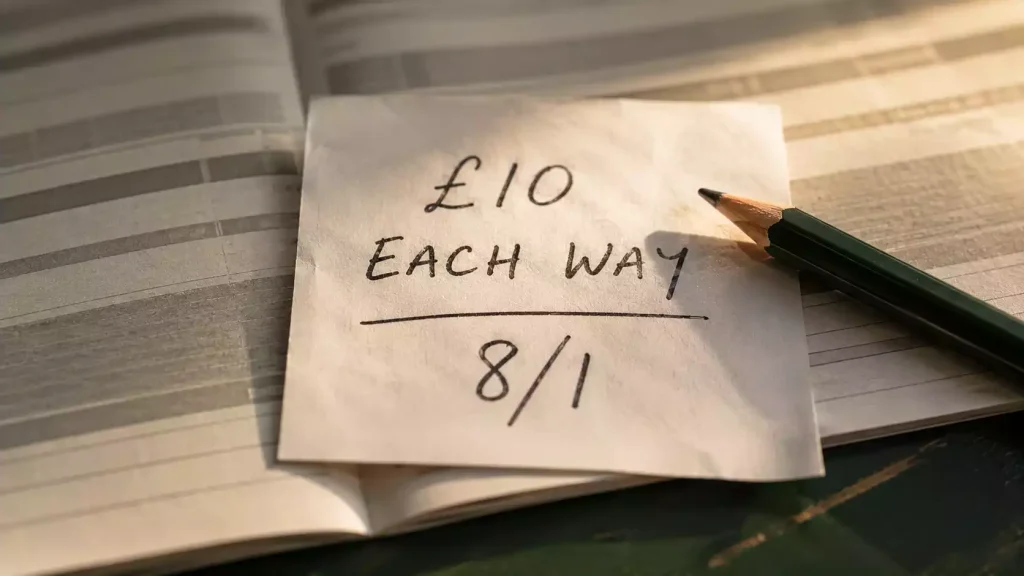
One Slip, Two Bets, One Distinctly British Idea
I lost my first each-way bet without realising I had won. That sounds impossible, so let me explain. I was nineteen, in a high-street shop on a Saturday in October, with a £5 each-way slip on a 12/1 outsider in a fifteen-runner handicap. The horse came third. I tore the slip up. The man behind the counter watched me, sighed, and asked whether he could have the pieces back. He sellotaped them together, settled the place portion at one-quarter odds, and handed me twenty pounds. I have written a small library of words about each-way bets since that afternoon, and none of them would have been written if that man had let me walk out.
The each-way bet is the most British thing on a betting slip. It is two bets sold as one. It is a hedge masquerading as a single product, and a single product hiding a hedge inside it. North American punters see the words and assume it is something like a “win and show” combination, but it is not — the structure is its own, the maths is its own, and the cultural reflex behind it is its own.
This guide is the one I wish someone had handed me in 1997. By the end of it, you will know exactly when an each-way bet earns its place on your slip, when it quietly drains your bankroll, and how to read the place fraction without squinting at small print.
Each-Way Bet in Horse Racing — More on this topic at bet to show horse racing .
How the Two Halves of an Each-Way Bet Are Built
Here is the simplest way I can put it: when you tick “each-way” on a betting slip, you are placing two bets at the same stake on the same horse, and the operator’s till is going to charge you double. If you stake £10 each-way, your slip costs £20. Half of that — £10 — is a win single at the quoted win price. The other half — £10 — is a place single at the place fraction, on whatever places the operator’s terms cover for that race.
That doubling catches more newcomers than any other element of the bet. People write “£10 each-way” on a slip thinking the total cost will be £10. They get to the counter, the operator asks for £20, and they assume something has gone wrong. Nothing has. The slip is doing exactly what it says — placing both halves at the unit stake you wrote.
The two halves settle independently. If the horse wins, both halves pay out: the win portion at the full win price, the place portion at the fractional place odds. If the horse places without winning, only the place portion pays. If the horse finishes outside the paid places, both halves are dead. Three possible outcomes, two settlement engines, one slip.
That structure is the source of every misunderstanding about each-way returns. Punters look at “10/1 each-way” and assume the horse winning at 10/1 returns a tidy 10/1 on the whole £20 outlay. It does not. The win half returns 10/1 on its £10. The place half — assuming one-fifth place terms — returns 2/1 on its £10. Total profit on the £20 stake when the horse wins outright at 10/1 with 1/5 places: £100 (win profit) plus £20 (place profit), so £120 profit on £20 staked, an effective return of 6/1 on the combined outlay. Not 10/1. Not even close.
This is not a flaw in the bet. It is the design of the bet. The each-way is meant to widen the range of outcomes that pay you something, in exchange for diluting the headline price. If you understand that bargain going in, you can use the bet sensibly. If you do not understand it, you will spend years wondering why your “10/1 winners” never seem to add up to 10/1 returns. The answer is in the bundle, not the bookmaker.
One last note on structure. Each-way bets are not unique to singles. They roll into accumulators too — an each-way double, each-way treble, each-way Yankee — though every leg of the multi has to clear at least the place portion for the multi to keep running. The compounding effect is brutal in both directions, and that is a separate conversation for a longer day.
Reading the Place Fraction: 1/4, 1/5, 1/6 Explained
The place fraction is the most misread number on a betting slip. Punters look at “8/1 each-way at 1/5” and have no idea, in the moment, what their place portion is actually worth. Let me fix that in a minute of reading.
The fraction is simply a multiplier on the win price. “1/5” means the place portion pays one-fifth of the win odds. So an 8/1 horse running each-way at 1/5 places returns 8/5 on the place portion — call it 1.6/1 in decimal-friendly fractional terms. On a £10 place portion, that is £16 profit plus your £10 stake back, total return £26 on the place half. On a 10/1 horse with the same fraction, the place portion settles at 2/1, returning £30 total on a £10 place stake. The arithmetic is just division, but it gets done less often than it should.
The fractions you will actually meet on British cards in 2026 follow the same baseline that has held for years. Fields of five to seven runners pay two places at 1/4 of the win odds. Non-handicap fields of eight or more pay three places at 1/5. Handicaps of eight to eleven runners also pay three places at 1/5. Handicaps of twelve to fifteen runners pay three places at 1/4. Big-field handicaps of sixteen or more pay four places at 1/4. That table is the load-bearing column of every each-way decision you will ever make in Britain.
Why does the fraction move? Because the operator is balancing two variables: how many places to cover, and how generously to price each one. The trade-off is mathematically clean. More places to cover means each place is more probable, so the fraction has to tighten. One-fifth on three places is roughly the same expected payout as one-quarter on two places, give or take the operator’s margin. The big handicap line — four places at 1/4 — is the most punter-friendly cell in the table, which is why operators load extra-place promotions onto sixteen-plus runner handicaps more often than anywhere else.
The 1/6 fraction shows up occasionally, almost always on ante-post markets for major festivals where the operator wants to widen the place coverage to four or five without giving back too much value. If you see 1/6, treat it as a sign the operator has stretched the bet to compensate. It is not generosity; it is calibration.
There is one practical habit worth building. Before placing any each-way slip, read the fraction off the operator’s terms for that specific race, do the win-price-divided-by-the-denominator sum in your head, and write the place portion price on a notepad. If you cannot do that without checking, you should not be placing the bet yet. Twenty seconds of arithmetic at the start of the day saves a year of confusion.
Every Outcome of a £10 Each-Way, Step by Step
Theory is fine, but a single worked example does more for understanding than a thousand words of explanation. So I am going to walk a £10 each-way bet through every possible outcome at common price points, and you will see the structure clearly.
The slip: £10 each-way on a horse priced 8/1 in a ten-runner non-handicap. Standard place terms apply — three places at one-fifth. Total stake: £20. The win portion is £10 at 8/1; the place portion is £10 at 8/5, which is 1.6/1 in decimal-fractional shorthand.
Outcome A. The horse wins. Win portion returns £80 profit plus the £10 stake — £90 back. Place portion returns £16 profit plus the £10 place stake — £26 back. Total return: £116 on a £20 outlay. Profit: £96. Effective return on the combined stake: 4.8/1.
Outcome B. The horse finishes second or third. Win portion is dead — £10 gone. Place portion returns £16 profit plus the £10 place stake — £26 back. Total return: £26 on a £20 outlay. Profit: £6. The slip is alive, but only just.
Outcome C. The horse finishes fourth or worse. Both halves are dead. Total return: £0. Loss: £20.
Three outcomes, three settlements. That is the whole bet. Notice what the maths is really telling you. To break even across this bet — to recover the £20 stake — you need either an outright win (which returns £116, well above break-even) or you need the place portion alone to clear £20 in profit. At 8/1 with 1/5 places, the place portion clears only £6 in profit, which is to say: a placed horse on this slip leaves you £14 short of the win-outcome cushion. Place finishes are not “saving the slip” — they are softening the blow.
Now run the same bet on a 14/1 horse instead. Win portion: £10 at 14/1 returns £150 on a win. Place portion at 1/5 of 14/1 is 2.8/1, so the place portion returns £38 on a placed finish — £28 profit plus the £10 place stake. On a placed-without-winning finish, total return is £38 on a £20 stake — £18 profit. The place portion now does meaningful work; this is one of the geometries where each-way starts to earn its place on the slip.
Compare to a 3/1 favourite under the same terms. Place portion at 1/5 of 3/1 is 0.6/1 — sixty pence in the pound. A placed-without-winning finish returns £16 on a £20 stake. Profit: minus £4. The place portion is now actively losing money on its half; you are buying coverage and paying for the privilege.
The rule of thumb falls out of the maths automatically: each-way bets earn their structure at longer prices, dilute themselves on middling prices, and become punitive on short prices. Knowing where on that curve your horse sits before you click is the difference between using the product and being used by it.
When Each-Way Beats a Straight Win Bet
Here is the question I get asked more than any other by punters who have read three blogs and now believe each-way is a beginner’s tax: when, exactly, does the each-way structure actually beat a straight win bet of the same total stake? It is a good question, and the answer is unromantic — there is a specific geometry where each-way is the right call, and outside that geometry, the win-only single is usually mathematically superior.
The geometry: longer prices, bigger fields, races where outright winners are genuinely hard to predict but a horse that “ought to be in the mix” is plausibly there. Think a 16/1 second-tier handicap runner at the Cheltenham Festival, in a twenty-runner field with four places paid at one-quarter. The place portion on that slip settles at 4/1. A placed-without-winning finish on £10 each-way returns £50 — a £30 profit on the £20 outlay. The same £20 placed on the win single returns £340 if the horse wins, but zero if the horse merely places. The each-way bet pays you for outcomes that the win-only bet treats as failures.
That is the underlying logic of the bet: it sells you outcome coverage in exchange for headline-price dilution. The mathematics rewards the trade when the place fraction is meaningful (1/4, not 1/5), when the field is big enough to pay four places, and when the price is long enough that the place portion clears your win-portion loss with room to spare.
Outside that geometry, the maths gets shaky. A 5/1 second-favourite at 1/5 places in an eight-runner non-handicap is a textbook bad each-way bet. The place portion settles at 1/1 — even money — and a placed-without-winning finish on a £10 each-way slip returns £20, exactly your total stake. You have spent a Saturday paying to break even. The win-only £20 single on the same horse returns £120 if the horse wins, and £0 if it places. Different shape, but the expected value is harder to defend on the each-way.
The way I phrase this to friends who are starting out: each-way bets are not for backing the favourite. They are for backing the horse you can see running well but cannot quite see winning. If you genuinely believe the horse is the winner, place the win single. If you genuinely believe the horse is a 1-in-3 shot to finish in the frame but a 1-in-15 shot to win, then the each-way bet starts to argue for itself. That is a specific call, made horse by horse, race by race. It is not the default position.
When Each-Way Is Quietly Eating Your Edge
The honest version of this section is the one nobody puts on a bookmaker’s banner: most each-way bets do not earn their place on the slip. They are placed out of habit, comfort, or hedging instinct that does not survive contact with the maths. If you take nothing else from this guide, take this.
The underlying figure that confirms what I have seen across years of column-writing is the drift in UK racing turnover. Per-race betting turnover on British racing fell 8% year on year in 2024/25, 15% versus 2022/23, and 19% versus 2021/22 — three consecutive years of contraction. That decline does not name each-way as the culprit, but I have my suspicions. Punters who place 50% of their slips as each-way without thinking about price geometry are quietly bleeding bankroll into the place portion margin, and over a season that adds up to real money.
The three structural traps are these. First, short prices: anything 4/1 or shorter at 1/5 places puts the place portion at a price where the bookmaker’s implied margin is unforgiving. Second, small fields: 1/4 places on five to seven runners might look generous, but the win portion of a short-priced runner often turns the slip into a glorified place bet at fixed odds. Third, finals and championship races at flat handicap weights, where the variance on the place portion is high but the price is too short to compensate.
The other trap is psychological. Punters describe each-way bets as “safe”, which is the wrong word entirely. Each-way bets are not safe — they have a wider range of outcomes that return something rather than nothing, but the expected return on the place portion can still be negative. Safety is not the same thing as outcome diversity. A bet that pays back £6 on a £20 stake when it “wins on the place portion” is not a safe bet; it is a slow-bleed bet that returns less than your stake even when one of the two halves cashes.
The corrective habit is to ask, before every each-way slip: what does the place portion settle at, and is that a price I would back if it were a stand-alone single? If the answer is “no, that price is rubbish on its own”, you have your answer about the each-way too.
See also UK Horse Racing Bet Types .
Extra-Place Promotions: Marketing Trick or Genuine Value?
Operators have learned something about punter behaviour. People will engage with an “extra place” offer the way they will not engage with a “slightly improved fraction” offer, even though the two things are sometimes worth identical money. Big festival weekends — Cheltenham, Aintree, Glorious Goodwood, the Champions Day card — are now thick with extra-place promotions, and a punter who treats them all as equal value will leave money on the table.
The headline number that frames this every year: at the 2026 Grand National, most major UK operators paid six places at one-fifth odds, with one of the major firms going further and paying seven places — the deepest place coverage in the operator field. On a forty-runner field reduced to thirty-four, paying seven places means roughly one in five runners is in the money. That changes the calculus of an each-way slip dramatically. A 50/1 outsider that you fancied for a top-ten effort suddenly has a real chance of returning something.
So far, so generous. The catch is in the small print. Extra-place offers usually apply to the place portion only, which means you cannot strip out the win half and run a place-only bet at the extra-place terms. You have to take the each-way slip in full, which means doubling the stake and paying for the win portion at a price that may not justify itself. If you wanted £20 of exposure on a 50/1 horse to finish placed under enhanced terms, you are looking at £40 of total outlay — £20 dead on the win portion before the gates even open, unless the horse genuinely wins.
The second catch is that extra-place offers are concentrated on races where the bookmaker has already priced the place portion conservatively. Look at the place fractions on the Champion Hurdle or the Stayers’ Hurdle most years and you will see one-fifth fractions on fields where, on a normal race day, you might expect a touch more generosity. The “extra place” is partly compensation for a place fraction the operator has already squeezed. It is rarely pure value.
That said, extra-place offers do create real situations where the each-way bet is positively-priced for the punter. My rule of thumb is straightforward: if the operator is paying at least one place beyond the standard terms for that race, and the price is 16/1 or longer, and the field is genuinely competitive rather than dominated by a single market leader, the slip is worth a look. Below 16/1, the headline place coverage is doing less work than it appears, because the place portion price after the fractional cut is too short to compensate for the win portion’s drag.
I have written elsewhere about how these promotions specifically play out on the National — see my deeper piece on extra-place offers at the Grand National for the operator-by-operator breakdown — but the principle applies across the festival calendar.
The 2025 UK Each-Way Landscape in Numbers
Step back from the slips for a moment and look at the size of the room. Remote betting on horse racing produced £766.7 million in gross gambling yield in the financial year ending March 2025 — the second-largest betting vertical in the UK by yield, behind only football. That is not a niche pastime. That is a major retail category, and the each-way bet is the spine of it. If you stripped each-way slips out of the British betting menu, the entire commercial model of high-street and online racing would have to be rebuilt.
The underlying turnover figure tells a more uncomfortable story. Total turnover on British racing fell 9% in Q1 2025 versus Q1 2024, with core fixtures down 14.4% while premier fixtures held steady. The British Horseracing Authority’s Director of Racing, Richard Wayman, addressed it directly in the BHA’s Q1 blog: Total betting turnover has fallen by nine per cent compared with the same period in 2024. Whilst there is work to be done on the racing product to grow its appeal as a betting medium, there would be a much wider range of factors contributing to this concerning decline.
What does that decline mean for the punter weighing up an each-way bet in 2026? Two things. First, operators are competing harder for the each-way wallet share, which means the promotional layer on midweek cards has thickened. Second, the squeeze on operator margins has not changed the standard place fractions — those have held at 1/4 and 1/5 — but it has tightened how often operators offer enhanced fractions outside of headline events. The structural product is broadly the same; the giveback is more aggressive in narrow windows and more conservative outside them.
The other useful number is the seasonality. Horse-race betting participation in the UK in the past four weeks was 7% in Wave 2 2025 (April-July), up from 4% in Wave 1 (January-April), then reverted to 4% by Wave 3 (July-October). That is the spring-summer festival season doing exactly what you would expect — drawing in a flood of casual punters who place each-way slips on horses they have never heard of, and then losing them again when the high-profile fixtures end. If you are a serious each-way punter, the implication is clear: the markets are softest when the casual money is in them, which means the festival weeks are when the cleverly-priced each-way bet has the most competition for the prices, and the quieter weeks are when the operators’ margins are most exposed to a thoughtful slip.
Five Mistakes Punters Make on Their First Each-Way Slip
Five mistakes account for most of the bad each-way slips I see. None of them is exotic. All of them are quietly expensive. Here they are, in roughly the order I see them in real punters.
The first is writing “£10 each-way” on a slip without checking that you have £20 in the account to cover it. I have personally watched this happen at a self-service terminal — the punter taps in the stake, the slip declines, the punter mutters something about the system being broken, and the queue starts looking sideways. Each-way is two bets. Always double the unit stake to find the total cost. There is no exception.
The second is backing odds-on favourites each-way. At 4/9 with 1/5 places, the place portion settles at 0.09 to 1. A placed-without-winning return on a £10 each-way is £20.90 on a £20 stake — ninety pence in the pound, which is to say, a loss. People place these slips because the each-way wrapper feels protective. It is not. On odds-on horses, the place portion is actively bad for you. Take the win single or do not bet.
The third is not reading the place terms for that specific race. The operator’s app shows them; the high-street terms sheet shows them; the racing pages show them. Failing to read them means you do not know how many places pay or at what fraction. That is the difference between a horse that came in third earning you a return or a horse that came in third earning you nothing. The two-minute habit of checking before every slip is non-negotiable.
The fourth is treating extra-place promotions as automatic value. They are not. Half of them are over short-priced fields where the place portion is too short to compensate for the win-portion drag even with the extra place added. The other half are over fields where the extra place is doing real work. The only way to tell the difference is to do the arithmetic on the place portion price, race by race.
The fifth is rolling each-way bets into accumulators without modelling how the place portion compounds. Each-way doubles and trebles can be a powerful tool, but the maths is unforgiving, and the place fraction multiplied across three legs of a treble is a small number very quickly. Run the worked example before you place the bet — not after.
Frequently Asked Questions
Why does my each-way return look smaller than the win price suggests?
Because the each-way return is the combined settlement of two separate bets, and the place portion settles at a fraction of the win price, not the full win price. A £10 each-way on a 10/1 winner under 1/5 place terms returns £120 profit on £20 staked — the win half returns at the full 10/1 on its £10, and the place half returns at 2/1 on its £10. The combined effective rate is 6/1 on the total outlay, not 10/1. The headline price is being diluted by the place portion's fractional settlement, which is the structural design of the bet.
Is each-way ever the correct play on an odds-on favourite?
Almost never on standard place terms. A 4/9 horse at 1/5 places settles the place portion at 0.09 to 1 — nine pence in the pound. A placed-without-winning result on a £10 each-way returns less than the £20 stake, locking in a small loss even when the bet 'wins' on the place portion. The narrow exception is a non-handicap with a runaway market leader where the operator has enhanced the place terms, but that scenario is rare. As a default, odds-on shots are win-only bets.
How do I read 8/1 each-way at 1/5 odds in plain English?
The win portion is at 8/1 — eight pounds profit per pound staked if the horse wins. The place portion is at 8/5 of the win odds, which is 1.6/1 — £1.60 profit per pound staked if the horse finishes inside the paid places. On a £10 each-way stake, the slip costs £20 total. If the horse wins, total return is £116 (£90 from the win half plus £26 from the place half). If the horse places without winning, total return is £26. If the horse finishes outside the places, total return is zero.
Do extra-place offers apply to both halves of the bet?
Almost always no. Extra-place promotions apply to the place portion of an each-way bet — they extend the number of places that pay out on the place half. The win portion is unaffected by extra-place offers; it still settles only on a first-place finish at the standard win price. You cannot strip out the win half and run a place-only bet at the enhanced terms; the operator requires the full each-way slip to qualify for the extra place.
Guides
Non-Runner No Bet: The Safety Net on Early Markets, Explained
The Three-Letter Acronym That Saves Ante-Post Punters The Wednesday before the 2024 Grand National, I watched a colleague walk into the office almost shouting. He had taken Corach Rambler at…
1/4 vs 1/5 Each-Way Odds: The Fraction That Quietly Decides Your Returns
The Small Print at the Top of the Slip That Changes Everything…
Betting on the Kentucky Derby From the UK: A Show-Bet-Curious Punter's Guide
The First Saturday in May, Translated for a London Slip The Kentucky…
UK Tote vs American Totalisator: Same Idea, Different National Identity
One Machine, Two National Roles An engineer in 1865 invented a counting…
What Does "To Show" Mean in Horse Racing? Plain-English Definition for UK Readers
The Three-Word Phrase That Means One Specific Thing The first time someone…
