
How to Read a UK Racecard: The Strip of Numbers That Decides Your Slip
 Available in US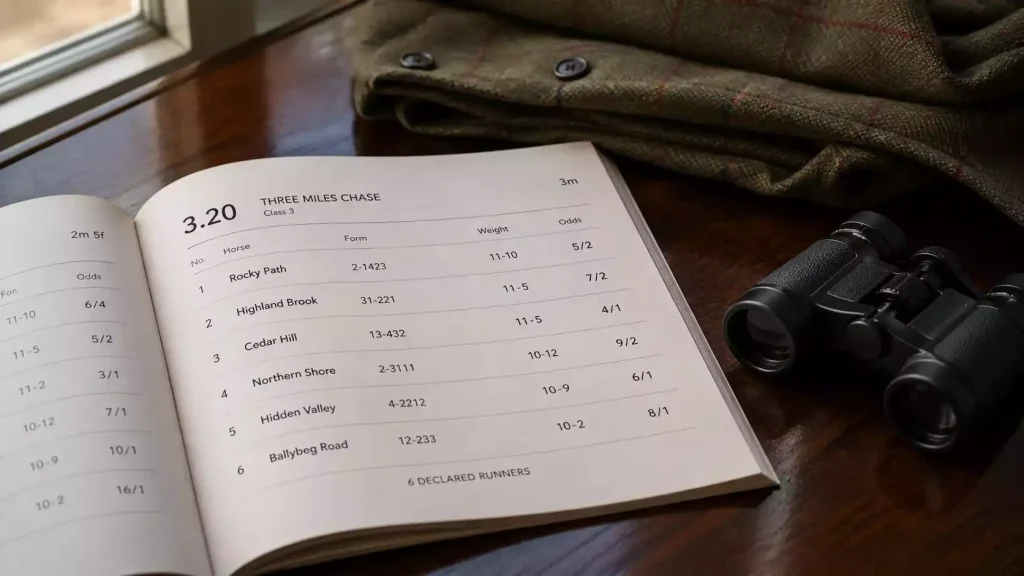
Decoding a Racecard in Three Minutes Flat
My father taught me to read a racecard at Goodwood in July 1998. I was twelve. He pointed at the form figures column – a strip of digits, letters and dashes that meant nothing to me – and said the entire race could be read from those six characters per horse, if you understood what each character meant. By the end of the afternoon I could decode the column in my head, and within a year I could read a card faster than the form-section commentary in the racing press. It is still the single most useful piece of racing literacy any punter can acquire.
The British racecard is a remarkable piece of compressed information design. A single page typically conveys, for each runner: recent form, weight carried, age, official handicap rating, draw number, jockey, trainer, owner colours, betting forecast price, course-and-distance history, going preferences, equipment, and any first-time changes. The information density is genuinely high, and a competent reader can extract a usable picture of the race in under three minutes once the conventions are understood.
What follows is a column-by-column walkthrough of the modern British racecard as it appears in the racing press, on race-day programmes and on the major operator websites. The conventions are essentially standardised across publication formats, with minor cosmetic differences in column order and abbreviation style. Master the conventions in one publication and you can read them all.
How to Read a UK Racecard — More on this topic at bet to show horse racing .
The Form Figures Column, Character by Character
The form figures column is the heart of the racecard. It typically appears as a six-character string immediately after the horse’s saddlecloth number and name, showing the horse’s most recent six runs in chronological order with the most recent run at the right-hand end. Each character represents one specific previous run, and the conventions are tightly defined.
Digits 1 through 9 represent finishing positions: 1 means the horse won that race, 2 means it finished second, and so on up to 9. A 0 (zero) represents a finishing position of 10th or worse – the racecard does not distinguish between 10th, 16th and last, all of which appear as 0. The dash character separates seasons or breaks of significant duration, and the forward slash separates calendar years.
The letter codes capture non-finishing results. P means pulled up (the horse did not finish, usually in a National Hunt race where the jockey eased the horse out of the race rather than completing the trip). F means fell. U means unseated rider. B means brought down (the horse was prevented from completing the race by another horse falling in front of it). R means refused. S means slipped. O means ran out. Each of these tells you something different about why the horse failed to complete, and the distinction matters: a horse that fell at the last in a major handicap is in a different category from a horse that refused at the first.
A worked reading of a form string. The form figures “12-3PF” tell you: most recent run was a fall (F); the run before that was a pull-up (P); before that, a third-place finish (3); a dash indicating a season break; then a second-place finish (2) and a win (1) in the previous season. The horse had a strong previous campaign, has been struggling in the current one, and would normally be priced relatively long for its next run.
The form-string reading should be combined with the recency information that the racecard provides separately – typically the days-since-last-run column, which tells you how long ago each represented run was. A horse with “12-3PF” form figures and a 14-days-since-last-run is in active campaign mode and has plenty of recent evidence to read; a horse with the same form figures and a 240-days-since-last-run is returning from a layoff, and the form pattern needs to be interpreted with that gap in mind.
One subtle convention worth knowing: bold or italicised form figures sometimes indicate runs at the current course or distance, with a legend usually printed at the foot of the card. The emphasis is a useful at-a-glance indicator of course-and-distance form.
Weight, Age and Official Rating
The weight column tells you what each horse carries in the race, expressed in stones and pounds with the abbreviation “st” and “lb”. A weight of 11-7 means 11 stones 7 pounds. The weight a horse carries combines its allocated weight under the handicap conditions, any apprentice or conditional jockey allowance, and any penalties or claims that apply for that specific race.
Handicap races allocate weights based on each horse’s official rating, with higher-rated horses carrying more weight. The mechanism is designed to give every horse in the race a roughly equal chance of winning by adjusting weight to reflect ability – a system that has been the structural defence of British handicap racing for over a century. The weight column on a handicap card is therefore a direct reflection of the BHA handicapper’s view of each horse’s relative ability.
The age column appears as a single number, typically between 2 and 14 depending on the race. Two-year-olds compete only in races written for two-year-olds, three-year-olds in races written for three-year-olds, and so on. Most British Flat racing happens between three- and five-year-olds, while National Hunt racing extends the active age range up to 11 or 12 in some cases. The age tells you something about the horse’s typical improvement trajectory – a five-year-old in a handicap is at peak ability, a three-year-old is likely still improving.
The official rating – usually abbreviated “OR” – is the BHA handicapper’s numerical assessment of each horse’s ability. The rating scale runs roughly 0-140 for Flat racing and 0-180 for National Hunt, with higher numbers indicating better horses. The rating updates after each run based on the handicapper’s view of the performance, and the trend of recent ratings tells you whether the horse is improving, declining or stable.
The rating column should be read alongside the weight column. A horse rated 95 carrying 11-2 in a handicap is being treated by the handicapper as a relatively weighted horse for its ability; a horse rated 95 carrying 10-4 is being treated as relatively well-weighted. The combination of OR and weight is the cleanest single read on the handicapper’s view of each horse’s chance, and disagreement with the handicapper’s view is the structural source of value bets in handicap racing.
Going, Distance and Conditions
The going report – the description of the racetrack surface condition – is one of the most race-shaping variables on the card. Going is reported on a scale that runs from “Heavy” (deep, holding ground after sustained rain) through “Soft”, “Good to Soft”, “Good”, “Good to Firm” and “Firm” (fast, dry ground). The convention varies slightly between Flat and Jump racing, with Jump going descriptions tending to skew softer.
Each horse has going preferences derived from its previous form. A horse that has won repeatedly on Heavy ground but never finished a race on Firm is a specialist soft-ground horse, and its chance in a given race depends substantially on the going report. The racecard typically shows each horse’s going record either as a separate column or in the past-performance section, with figures showing the number of wins on each going category.
The distance column shows the race’s official distance, typically expressed in miles, furlongs and yards. A 1m4f race is one mile, four furlongs (12 furlongs total). A 2m5f110y race is two miles, five furlongs and 110 yards. Each horse has a distance preference derived from its winning record at different trips, and the most successful horses tend to have a relatively narrow optimal distance range.
“In the UK, racing and betting have a unique interdependency that goes back over 200 years. A day at the races includes, for most participants, betting on horse races as well.” That observation from the European Commission in its 2017 State Aid clearance of the levy reforms captures the structural reason why the racecard’s information density has evolved to the level it currently has. The British punter has been reading these cards for two centuries, the conventions have been refined through that history, and the resulting information design serves a very specific dual purpose – supporting both casual on-course punters and serious form analysts.
Course-specific factors are the final layer. Some courses have idiosyncratic features – tight turns, long uphill finishes, sharp downhill descents – that favour specific horse types. The racecard usually flags course-and-distance winners with a small icon, indicating that the horse has won at this course over this distance before.
See also Placepot, Jackpot and Quadpot .
How Field Size Connects to Place Terms
The field size – the number of declared runners – is shown at the top of each race section and is the single most important number for each-way bettors. The UK place-terms scale is hardwired to field size: races with 1-4 runners are win only with no each-way terms available; 5-7 runners pay 2 places at 1/4 of the odds; 8 or more non-handicap runners pay 3 places at 1/5; 8-11 handicap runners pay 3 places at 1/5; 12-15 handicap runners pay 3 places at 1/4; 16 or more handicap runners pay 4 places at 1/4.
The field-size trend in British racing has been gently negative over the past decade. Average flat field sizes have fallen from approximately 9.14 runners per race to 8.9 runners, while jumps field sizes have fallen from approximately 8.49 to 7.84 runners. The contraction is partly a function of breeding decisions, partly a function of the prize-money structure that has shifted incentives toward fewer-but-stronger runners, and partly a function of trainer behaviour optimising for individual horse welfare rather than maximising race-day participation.
The structural implication is that each-way opportunities are slowly contracting. A handicap that would have run with 14 runners and offered 3 places at 1/4 a decade ago might now run with 11 runners and offer 3 places at 1/5 – a meaningful reduction in each-way payout for the same race profile. The trend has been gradual but cumulative, and any punter who has been betting consistently for ten years has experienced the effect.
The operator-side response has been to overlay extra-place promotions on top of the standard scale, particularly on the festival days. The 2026 Grand National’s 6-place promotions across most major operators (with Sky Bet stretching to 7 places) effectively counteract the standard-scale contraction for the major events, but the day-to-day racing calendar has seen no equivalent operator-side intervention. The marginal each-way slip on a Wednesday evening Wolverhampton card has less generous terms than the same slip on the same race profile a decade earlier.
The field-size column should therefore be read with the place terms in mind. A 16-runner handicap is a structurally better each-way race than a 12-runner equivalent, because 4 places at 1/4 covers a higher proportion of the realistic finishing-position distribution than 3 places at 1/4. The same logic applies to non-handicaps: 8+ runner non-handicaps pay 3 places at 1/5, while 5-7 runner non-handicaps pay only 2 places at 1/4. The marginal eighth runner can materially improve the each-way arithmetic.
The natural progression from reading a racecard well is understanding the products that the card-reading actually feeds into. Beyond standard win and each-way slips, the British Tote offers a family of multi-leg pool bets – Placepot, Jackpot and Quadpot – that turn the same form-reading discipline into a structurally different bet. The detail of how those pool products work is something I’ve broken down in the piece on Placepot, Jackpot and Quadpot in UK tote pools.
Frequently Asked Questions
What does a P or F in the form figures mean?
P stands for pulled up - the jockey eased the horse out of the race rather than completing the trip, usually because the horse was distressed, lame or simply not travelling well. F stands for fell - the horse made a mistake at a fence or hurdle and went to the ground. Both letters appear most commonly in National Hunt form because the Jump racing format produces more non-finishing results than Flat racing does. A 'P' is generally less concerning than an 'F' for future runs because it usually reflects a tactical decision rather than a physical incident.
Where on a racecard do I find the current place terms?
The place terms are usually shown at the top of each race's section, typically alongside the field size and the race name. Operator websites show the active each-way terms in real time, which may include enhanced-place promotions above the standard scale for major events. Print racecards in the racing press show the standard scale based on declared field size; the operator's website is the authoritative source for whether any promotional uplift applies on a specific day.
Guides
Betting on the Kentucky Derby From the UK: A Show-Bet-Curious Punter's Guide
The First Saturday in May, Translated for a London Slip The Kentucky Derby starts at five past midnight British time. The bugle plays, the field of twenty hits the gate,…
Who Bets on Horses in Britain? Reading the 2025 GSGB Like a Punter
The Statistical Portrait of the Average British Racing Punter If you had…
Forecast and Tricast in the UK: Picking the Top of the Photo Finish
Picking the Order Where Show Bets Stop Being Useful The first Tricast…
Place-Only Bet in the UK: The Sneakiest Slip on the Modern Market
Why the "Place" Half Walked Out on Its Own I first noticed…
Extra Place Offers at the Grand National: Genuine Edge or Promotional Mirage?
The Place Count That Operators Compete On On National morning 2024 I…
