
Parimutuel vs Fixed Odds in the UK: Why British Punters Picked One and Stuck With It
 Available in US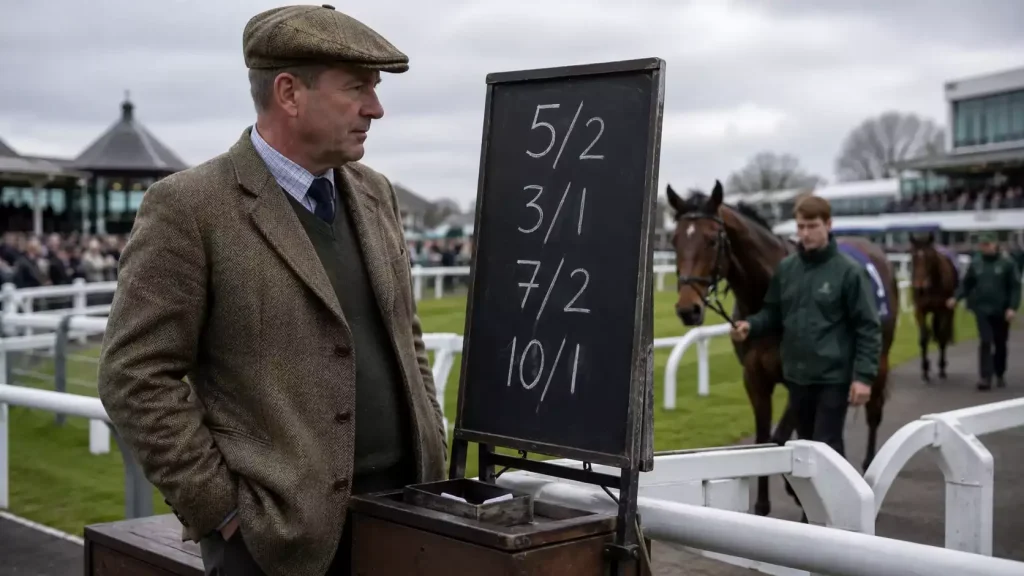
The 95/5 Split That Shapes Every British Slip
Walk into any UK betting shop on a Saturday afternoon and count the screens. The big ones show fixed-odds prices, race by race, runner by runner, with starting prices, ante-post markets, each-way fractions all advertised before the off. The Tote screen tucked in the corner, with its rolling dividends and pool totals, looks like a quaint anachronism. That layout is not an accident. It is the visual confession of a market that long ago picked its side.
Parimutuel betting accounts for only about 5% of total UK horse-racing betting turnover, while fixed-odds bookmaking accounts for essentially everything else. The split is so lopsided that most British punters under 40 have never placed a Tote bet in their lives. Compare that with France, where the PMU operates a state-protected parimutuel monopoly, or the United States, where the tote is the only legal channel at the track. Britain’s preference for the bookmaker is not the global norm – it is a national peculiarity with deep historical roots.
That 95/5 ratio is not a quirk. It is the single most important structural fact about UK racing betting, and it explains why so many imported American terms – “show,” “across the board,” “exacta” – never quite fit on a British slip. They were built for a pool system that British punters quietly walked away from a long time ago.
Parimutuel vs Fixed Odds in the UK — More on this topic at bet to show horse racing .
Parimutuel Mechanics, Briefly and Without Jargon
Parimutuel is French for “mutual betting.” The idea is straightforward: every punter who backs the same outcome contributes to a shared pool, the operator takes a fixed percentage cut, and the remainder is divided among the winners. There is no bookmaker carrying risk, no advertised price before the off, no overround. The price emerges from the collective action of everyone betting into that pool.
Imagine a small race with three horses and a pool of £1,000 in total bets across the field. £600 goes on Horse A, £300 on Horse B, £100 on Horse C. The operator takes its 20% cut, leaving £800 in the prize fund. If Horse A wins, the £800 is divided among the £600 of A-backers – a return of roughly £1.33 per £1 staked, or odds-on at about 1/3. If Horse C wins, the £800 goes to the £100 of C-backers – a return of £8 per £1, or 7/1. The longshot pays vastly more not because someone priced it that way, but because almost nobody bet on it.
The same mechanic runs across the win, place and show pools in American racing, and across the Tote’s win, place, exacta and Placepot pools in the UK. Three independent pools per race, three independent dividends. A Tote dividend updates in real time on the boards. A bookmaker’s fixed price does not update at all once you have struck the bet.
The advantage of parimutuel is honesty in a particular sense: the operator cannot lose. The cut is taken before any distribution, so the pool is always self-balancing. The disadvantage is that the price is not visible until after the off, which makes value-hunting almost impossible in the conventional sense. You cannot say “I’m getting 4/1 about a 3/1 chance” because there is no advertised 4/1.
Fixed-Odds Bookmaking and Risk-Carrying
The fixed-odds model is the opposite philosophy in almost every respect. The bookmaker prices each runner before the off, displays those prices, and accepts bets against them. If you back a 5/1 shot, you collect 5/1 regardless of how the rest of the market moved. If the price drifts to 8/1 by the off, your earlier ticket still settles at 5/1. The bookmaker has taken on the price risk; you have taken on the result risk.
The mechanic that makes this work is the overround. A book is balanced when the implied probabilities of all runners add up to slightly more than 100%. The excess – typically 110% to 130% on a UK race depending on field size and competitiveness – is the bookmaker’s theoretical margin. In practice, books are rarely perfectly balanced and operators absorb fluctuations through volume and hedging, but the overround is the engineering principle.
Fixed-odds also opens up promotional architecture that parimutuel simply cannot offer. Best Odds Guaranteed, extra place offers, price boosts, free bet refunds when your horse finishes second – all of these are bookmaker creations that depend on the operator being able to vary the price after the bet is struck. A parimutuel pool has no price to vary. The dividend is a function of the pool’s distribution, not a number the operator chose. You can boost a horse from 6/1 to 8/1 on a fixed-odds slip. You cannot meaningfully “boost” a show pool.
This is also why the UK each-way market exists in its current form. Each-way is two bets in one – half on the win at the full price, half on the place at a fractional reduction (1/4 or 1/5 of the win price) – and both halves settle at the price advertised before the off. The structure is impossible inside a pure pool system, because there is no advertised place price to apply a fraction to. The British each-way slip is essentially a fixed-odds invention dressed as a hedge.
Why Britain Built Its Sport Around Fixed Odds
The fork in the road came earlier than most people realise. By the 1850s, British racecourses already operated a thriving ring of on-course bookmakers chalking prices on boards beside the parade ring. The Totalisator Act of 1928 introduced state-licensed pool betting at British tracks, but by then the ring was the cultural and commercial centre of British racing. The Tote arrived as a supplement, not a replacement. America, by contrast, banned bookmaking on most state tracks in the early twentieth century, leaving parimutuel as the only legal channel.
The cultural attachment runs deep. The European Commission, reviewing British racing’s legal framework, summarised it neatly: in the UK, racing and betting have a unique interdependency that goes back over 200 years, and a day at the races includes, for most participants, betting on horse races as well. That sentence appears in a 2017 state-aid clearance document about the Horserace Betting Levy, and its understatedness is exactly right. The betting ring is not an accessory to British racing; it is constitutive of the experience.
The economics reinforce the cultural pattern. Fixed-odds bookmaking generated £766.7 million in gross gambling yield from remote horse-race betting in the financial year ending March 2025. That is not the turnover, that is the margin – the operators’ aggregate take after winners are paid. Football is the only sport that beats it. A market that produces that scale of margin is not going to be displaced by a pool product running at 5% of total turnover.
The off-course revolution of the 1960s onwards locked the pattern in. When betting offices were legalised in 1961, they were licensed primarily to take fixed-odds bets on horse racing, with Tote bets as an afterthought. By the 1990s, every high-street shop had a bank of fixed-odds screens and a single Tote terminal in the corner. The Tote itself was eventually sold to a consortium of horseracing interests in 2011 and rebranded several times. Its survival owes more to the Placepot – a multi-leg pool game that British punters genuinely enjoy – than to single-race win, place or show pools.
See also UK Tote vs American Totalisator .
Where the UK Tote Still Has a Real Role
Despite the 5% market share, the British Tote is not dead. It runs strongest in the multi-leg pool games that fixed-odds books cannot replicate efficiently. The Placepot – pick a placed horse in six consecutive races on a card – is the headline product, and the prize funds on Festival Wednesday at Cheltenham can run into six figures. The Jackpot, Scoop6 and Quadpot follow the same structural logic of stitching multiple races into one ticket.
The single-race Tote markets – Tote Win, Tote Place – still exist, mostly as a tactical alternative when a punter suspects the SP will be shorter than the Tote dividend. That sometimes happens on lightly raced or low-profile runners where the on-course book has overcompensated and the pool has not. It is a niche pursuit. Most British punters who use Tote Win on a single race are either ex-Tote employees, dedicated tote-watchers or pensioners who started before fixed-odds got friendly.
The Tote also handles US-style pool exotics for British punters who want to bet into American pools on big race days. A UK account with the right operator can hit a Pick 6 at Santa Anita or a Daily Double at Belmont without leaving the kitchen table. That cross-border function – moving British money into American pools – is genuinely useful and is the closest a UK punter ever comes to a true show bet on a US race.
The Tote’s wider role in the racing economy is to be the visible counterweight that lets industry figures argue British racing is not entirely captured by fixed-odds bookmakers. It is symbolic as much as commercial. Behind every Saturday afternoon ITV broadcast, the cultural balance between the ring and the pool is part of what makes British racing feel different from its American counterpart. The 5% pool share is small, but it is structurally important, and the way the same pool machinery works on the other side of the Atlantic is covered in the side-by-side of the UK Tote and the American totalisator.
Frequently Asked Questions
Is the UK Tote a state-owned operation today?
No. The Tote was sold by the government in 2011 to a consortium and has changed hands and rebranded several times since. It is now a privately-owned operator running parimutuel pools on UK racing. The state-owned era ended over a decade ago.
When does a fixed-odds price beat a Tote dividend, and vice versa?
Fixed-odds usually beats the Tote on heavily-backed favourites, where bookmakers compete on price and the pool flattens returns. The Tote often beats fixed-odds on lightly-raced or unfancied runners where the pool has under-priced the horse relative to its true chance. Smart punters check both before striking.
Guides
The Quiet Death of the British Betting Shop: 22.8% Fewer Doors Since 2019
Why the High Street Bookmaker Is Vanishing One Window at a Time The Ladbrokes on the corner of my high street in 2018 had three live screens, two self-service betting…
Win-Only vs Each-Way: A Decision Framework Without the Marketing Spin
One Slip Splits Two Ways: Choosing in Under Thirty Seconds I sit…
Dead Heat Rules in Horse Racing: How Two Horses Splitting a Place Splits Your Stake
When Two Horses Cross Together and Your Slip Goes Strange It happened…
UK Black-Market Betting in 2025-2026: The Numbers the Industry Argues About
The Parallel Market Nobody Wants on Their Spreadsheet I first noticed the…
The UK Horse Racing Levy, Explained: Where the Money in Your Slip Eventually Lands
The Quiet Tax on Every Bet on British Racing Every time I…
