
Show Bet Payout Calculation: How the Pool Splits Three Ways
 Available in US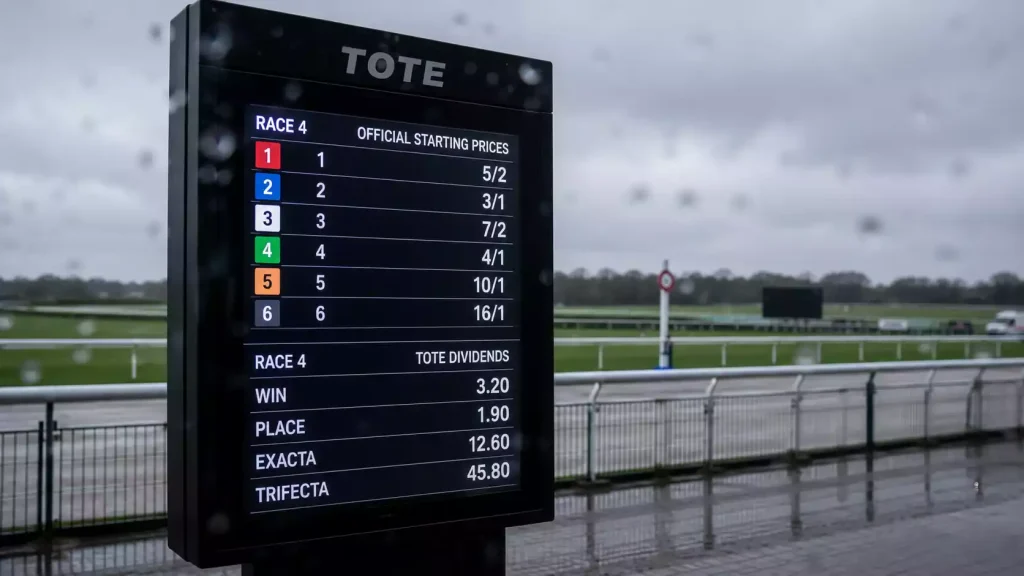
Why a Show Dividend Is Almost Never Round
The first time I watched a friend collect a winning show ticket at Saratoga, he looked at the printout and laughed. He had backed a 4/1 shot to show. The ticket paid $3.60 on a $2 stake. Not $5, not $4.80, not anything that looked like a fractional price. Just an oddly specific number with a 10-cent tail. That awkward decimal is the signature of the parimutuel show pool, and it tells you everything about why this product behaves nothing like a UK each-way slip.
British punters are conditioned by fixed-odds bookmaking. You see 5/2, you back it for £10, you collect £35 if it wins. Clean, predictable, advertised before the off. The show pool offers no such courtesy. The dividend is calculated after the result, from the pool of money everyone else has put in, with the house taking a slice in the middle. The number you collect is whatever the maths produces. It is almost never round, almost never advertised, and almost never the price you thought you were getting.
The mechanic is worth understanding even if you never plan to bet a US show ticket in your life, because it underpins a lot of the cultural difference between American and British racing. UK punters trust the boards. American punters trust the pool. Both groups are right within their own systems.
How the Show Pool Is Built Before the Off
The pool starts at zero on the morning of race day. Every show ticket purchased anywhere in the network – track-side tellers, off-track parlours, online tote operators – flows into the same shared bucket for that specific race. By the time the gates open, the total can range from a few thousand dollars on a midweek card at a regional track to several million on Breeders’ Cup Saturday.
The crucial thing for a UK reader is that this pool is not the operator’s money. It is the punters’ money. The track does not set the show price; the punters do, collectively, by how they distribute their stakes across the runners. If 70% of the show pool ends up on the favourite, the favourite will pay close to the legal minimum because the maths has no other choice. If 70% ends up on the favourite and the favourite finishes fourth, the entire show pool – minus takeout – is split among the backers of whichever three horses actually finished in the frame, and those backers collect handsomely.
The pool is also dynamic right up to the off. American tote boards display indicative dividends – “will pays” – that update every few seconds as new money comes in. A horse that opens at a projected $3.20 show payout might be paying $2.40 by the time the stalls open if late money piles in. The final dividend is locked the instant the last ticket is sold, which is usually within seconds of “off.”
This is a structurally different product from anything on the British high street, where the operator carries the risk and prices it accordingly. The pool model puts the punter against other punters, with the track taking a cut for hosting the contest. A surprisingly stable fact is that pari-mutuel betting accounts for only about 5% of total UK horse-racing betting turnover – which is the cleanest single-number explanation for why this kind of arithmetic feels alien on British screens.
Takeout, Breakage and the Hidden Slice the House Keeps
Two words that almost no UK punter knows: takeout and breakage. They are the twin mechanisms by which the track keeps itself running and the state collects its tax. They also explain why your show dividend is never the figure you calculated in your head.
Takeout is the headline cut. On most US tracks the takeout on the show pool runs between 15% and 18%, depending on jurisdiction. Some pools are higher. Some are lower. The number is published, regulated by state racing commissions and applied before any dividend is calculated. So a $100,000 show pool with an 18% takeout has $82,000 left to distribute across the winners.
Breakage is the part that genuinely surprises people. After takeout, the remaining pool is split among the three winning groups, and within each group the per-dollar payout is calculated. That per-dollar figure is then rounded down to the nearest 10 or 20 cents. The cents that get rounded off – the “breakage” – are kept by the track. On a high-volume race the breakage alone can be worth thousands of dollars. On a low-volume race it can shave a meaningful chunk off your individual dividend.
To put real numbers on it, take a £10 stake equivalent into a show pool with the following structure. Pool total: $100,000. Takeout at 18%: pool now $82,000. Your horse is the third-place finisher, attracting $12,000 of the show pool. Your $10 stake is one of those tickets. The third’s share of the post-takeout pool is one-third of $82,000, so about $27,333. Distributed against the $12,000 backed on that horse, that’s roughly $2.28 returned per $1 staked – but breakage rounds it down to $2.20. You collect $22 on your $10 stake. The eight cents per dollar that vanished is the breakage.
The takeout figure matters strategically too. A horse-racing-betting market with 18% takeout is hostile to consistent profit in a way fixed-odds books are not, because the operator’s cut is built into the dividend itself rather than into a bookmaker’s overround. The cut compounds over time. UK remote betting on horse racing generated £766.7 million in gross gambling yield in the financial year ending March 2025, which is essentially the bookmakers’ aggregate margin on British racing turnover over twelve months. The same kind of cut exists in the US tote system but is taken out of the pool race by race, ticket by ticket.
Splitting What Remains Across Three Finishers
Once takeout has been removed, the remaining pool is divided into three roughly equal shares – one for the winner’s show backers, one for the second-placed horse’s show backers, one for the third’s. “Roughly” because the maths is more subtle than a clean third-and-third-and-third division. The track first refunds every dollar staked on the three placed horses out of the pool, then divides what is left.
Worked example. Pool $100,000, takeout 18%, post-takeout $82,000. Show money on first-placed horse: $20,000. On second: $15,000. On third: $10,000. Total backed on the three placed horses: $45,000. The track first refunds those $45,000 to the winning ticket holders – that is the return-of-stake portion. The remaining $37,000 in profit is then split into three equal shares of $12,333 each, with each share allocated to one of the three placed groups.
So the winner’s backers receive their $20,000 in original stake plus a $12,333 profit share, distributed across their tickets. The second’s backers get back $15,000 plus $12,333. The third’s backers get back $10,000 plus $12,333. That last group did best per dollar staked, because they had the smallest stake pool sharing an identical profit slice. This is the structural reason a horse heavily backed to show pays less than a long-priced horse to show – the same profit slice is being spread across more or fewer tickets.
The maths produces one consistent pattern across virtually every US race. The show dividend on the favourite is almost always the smallest of the three. The show dividend on the most neglected of the three placed horses is almost always the largest. And the gap can be vast: $2.20 versus $9.60 on the same race is entirely normal.
The $2.10 Floor and What It Tells UK Punters About Risk
Every US tote operator is legally bound to pay a minimum dividend on a winning show ticket. The figure varies slightly by jurisdiction but $2.10 against a $2 stake is the standard. That is a five-pence-equivalent profit on a pound staked. It is the parimutuel system’s confession that some show tickets are essentially zero-risk and that the maths needs a floor to keep them honest.
A British each-way punter is used to similar mechanics in the place portion of a slip. Back a 2/1 favourite each-way and the place part returns 2/5 (a quarter of 2/1 odds), which works out to a 40p profit on a £1 place stake. The American $2.10 floor is the same instinct – a tiny but non-zero return on a heavily favoured outcome – expressed through pool maths rather than fractional odds.
The “minus pool” scenario sits below this floor. When show money piles onto a single horse so heavily that even paying the legal minimum costs the track more than the takeout it collected, the track simply absorbs the loss. Minus pools are most common on huge odds-on favourites at small tracks where the pool is too thin to balance the favourite’s share. The track loses money on the race. Punters rarely notice, because the only flag is the dividend printed on their ticket.
What this tells a UK reader is that the parimutuel show product is mathematically designed to discourage betting on heavy favourites. A 1/2 favourite to show on a US race effectively returns about 5% to 10% on stake, which is barely enough to justify the trip to the window. A UK each-way slip on a comparable favourite returns nothing on the place half either, because the place portion at 1/5 of 1/2 is mathematically a loser before stakes are even considered. Different system, same brutal conclusion: short-priced safety nets do not pay.
If you want to dig deeper into why the British market chose a fixed-odds path while America stayed loyal to the pool, the contrast is worth its own piece – my look at why British punters picked one system and stuck with it covers the historical fork in the road.
Frequently Asked Questions
Can a winning show bet ever return less than my stake in net terms?
On most US tracks, no - the statutory minimum dividend of $2.10 against a $2 stake (a five-cent floor) guarantees at least a nominal profit. A handful of jurisdictions allow lower minimums, but the principle of a floor is near-universal. A losing ticket, obviously, returns nothing.
What is a minus pool, and why should I know about it?
A minus pool occurs when one horse attracts so much show money that paying the legal minimum dividend would cost the track more than it took in via takeout. The track absorbs the shortfall. It is rare and usually involves heavy odds-on favourites at smaller US tracks. UK punters mostly need to know it exists so they understand why some American show prices look strangely low.
Guides
UK Black-Market Betting in 2025-2026: The Numbers the Industry Argues About
The Parallel Market Nobody Wants on Their Spreadsheet I first noticed the scale of the UK unregulated betting market in a Telegram conversation in late 2023. A Bulgarian operator was…
Parimutuel vs Fixed Odds in the UK: Why British Punters Picked One and Stuck With It
The 95/5 Split That Shapes Every British Slip Walk into any UK…
Setting Limits Before You Bet: The Practical Account-Control Walkthrough
The Five-Minute Setup That Outperforms Willpower The most useful five minutes I…
Place-Only Bet in the UK: The Sneakiest Slip on the Modern Market
Why the "Place" Half Walked Out on Its Own I first noticed…
Best Odds Guaranteed in the UK: The Quiet Promotion That Actually Earns Its Keep
The Only Sportsbook Promotion Worth Reading Twice The Wednesday afternoon I learnt…
