
Horse Racing Betting for Beginners: A First Slip Without the Insider Jargon
 Available in US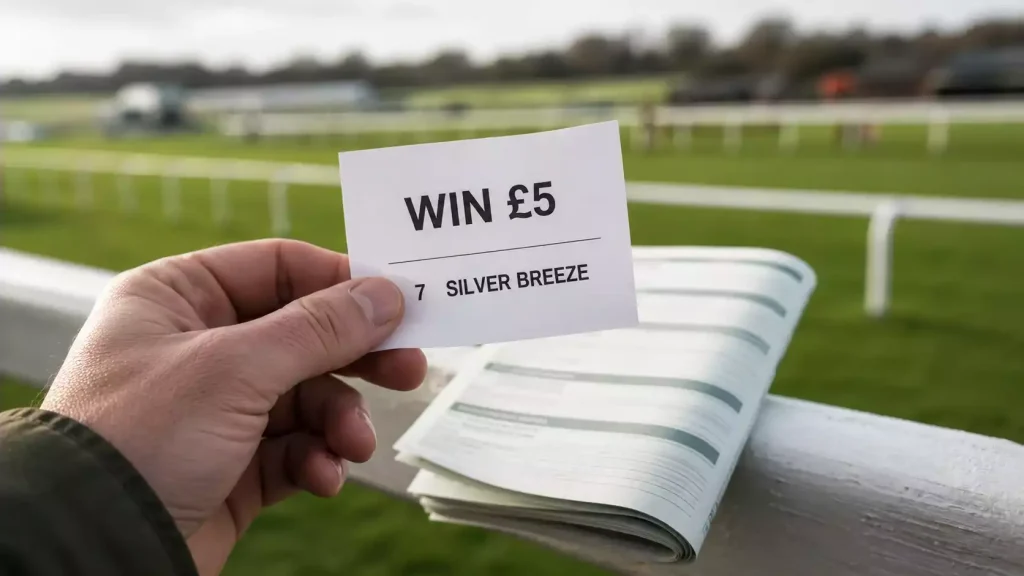
Reading This Before You Touch Your First Slip Saves You Money
I will start with the most useful sentence I can give a beginner: the people who lose the most money in their first year of betting on horses are the ones who pretended they understood things they did not. That is not a moral failing. It is what happens when a punter stands at a counter and would rather guess what “8/1 each-way at 1/5” means than ask. I have watched it for years, and the cost of the silence is real.
So this guide assumes nothing. If you have never placed a bet on a horse, never read a racecard, never opened a betting app, and never quite worked out the difference between a Yankee and a forecast, you are exactly the person I am writing for. I will not pretend the British system is simple, because it is not. But I will tell you which corners of it you can ignore for the first six months, and which corners are worth ten minutes of attention before you put a fiver on anything.
One promise. I will not steer you toward any particular operator, advise on which apps to install, or tell you what platform to use. The British market has a lot of operators, all of them adequate for a beginner, and the choice is more about which design you find easier to navigate than which one will improve your returns. Pick the one that looks legible to you, deposit the smallest amount you are prepared to lose entirely, and start there.
The Three Places You Can Actually Bet in Britain
Three doors lead into British horse-race betting, and which one you walk through changes the experience more than most beginners expect. The doors are the racecourse, the high-street shop, and the online account. They are not interchangeable.
The racecourse — the on-course experience — is the oldest version. Bookmakers stand in a ring with their prices on boards, calling out odds, taking cash, handing over paper tickets. You walk up, name your horse, name your bet, hand over the money. There are no algorithms between you and the price. The bookmaker is a person, doing maths in his head, and the price he offers is one he is prepared to honour. You will pay a small premium compared to online prices in some cases, but you will see how the market actually moves in front of you. It is the most educational way to bet for a beginner, even if it is the least convenient.
The high-street shop is the middle door. The number of licensed UK betting shops has fallen to 5,825 — a 22.8% decline since pre-pandemic levels — so the door is narrower than it was a decade ago. But the shops that remain offer something the app cannot: a counter, a printed slip, a person who can answer a question if you do not understand the form. The shop is where I learned the rhythm of the sport, and I still recommend a Saturday afternoon in one as the cheapest education in racing a beginner can buy.
The online account is the door most people walk through now. The OLBG editorial team summed up the migration neatly when reporting their 2025 Grand National survey: As the decline in high street bookmakers continues, our study reveals 62% of UK adults plan to bet on the Grand National online, 28% in a high street bookmaker and only 9% on-course at Aintree, showcasing how real-life trends are reflected in our survey results.
Online betting has obvious advantages — price comparison, instant settlement, full statement history, every promotion in one place — and one quiet disadvantage. You never see anybody else’s reaction to a race. You never overhear an experienced punter mutter “look at the second favourite drift” twenty seconds before the off. My advice to genuine beginners is to spend at least one afternoon at a racecourse and one at a shop before settling into the app permanently. The cost is small. The education is significant.
How to Read a Racecard Without Panicking
The racecard is the document that tells you what is happening on the day. It looks intimidating the first time you see one — lots of numbers, abbreviations, weights, jockeys, trainers — but the structure underneath is logical, and once you know what each column is doing, you can read it in about a minute per race.
At the top of the card sits the race header: race name, prize money, distance, going, age and weight conditions, and number of runners. The distance is given in furlongs (one furlong is one-eighth of a mile) and miles. The going describes the state of the ground — firm, good, good-to-soft, soft, heavy, and the variations in between. The going is the single most important variable for predicting performance after the form of the horse itself, because horses have surface preferences that are well-documented in their previous runs.
Below the header is the field, listed one row per runner. Each row typically contains: the horse’s saddlecloth number, the horse’s name, the trainer, the jockey, the weight the horse is carrying, the horse’s age, and a string of small symbols called the form figures.
The form figures are the encrypted history of the horse’s recent performances. A row that reads “11-3245” tells you the horse finished first in its last two starts, then third, then second, then fourth, then fifth. The hyphen is a year break; the numbers run right to left in time (most recent on the right). Letters in the string have specific meanings: P is pulled up, F is fell, U is unseated rider, BD is brought down. A long string of zeros is a horse out of form. A string of single-digit finishes is a horse running well.
The weight column matters for handicap races, where the official handicapper assigns each horse a weight designed to give every runner a theoretical equal chance. Heavier weights are slower; lighter weights are faster. The handicapper’s job is to make the field as competitive as possible, which is why handicaps tend to be the most reliable races to bet on — the chaos is intentional.
My advice for a beginner reading a card for the first time: pick one race, read every column on every runner, and try to predict the finishing order before the race starts. Do this without staking money. You will be wrong, often dramatically wrong, but you will learn what the form figures actually mean when they meet a real race.
Fractional vs Decimal Odds: The Same Number in Two Costumes
Britain bets in fractions. Most of the rest of the betting world bets in decimals. Same number, two costumes. If you understand both, you can move between markets without recalculating in your head every time.
The fractional odds you see on a British board look like “5/1” or “11/4” or “9/2” or, on a short-priced favourite, something like “4/9” or “evens” or “5/6”. The fraction tells you the profit on a unit stake. A 5/1 horse pays five pounds profit per one pound staked, plus the original stake back — total return on £1 is £6. An 11/4 horse pays eleven pounds profit per four pounds staked, so £20 staked at 11/4 returns £75 (£55 profit plus £20 stake).
“Evens” — sometimes written as 1/1 — means a profit equal to the stake. A pound on an evens horse returns two pounds total. “Odds-on” describes any price where the denominator is bigger than the numerator: 4/9, 1/3, 4/5. These prices return less profit than the stake, because the bookmaker considers the horse more likely than not to win. A pound on a 4/9 favourite returns £1.44 total — your pound back plus 44 pence profit.
Decimal odds are simpler in pure arithmetic terms. The decimal price is the total return per unit stake, including the stake. So 5/1 in decimals is 6.0, 11/4 in decimals is 3.75, evens is 2.0, and 4/9 is 1.44. To convert fractional to decimal, divide the numerator by the denominator and add 1.
The reason fractional persists in the British market is partly tradition and partly the speed of mental arithmetic at the rails. Most apps will let you toggle between the two formats — pick whichever one your brain processes faster, and stick with it. There is no analytical advantage to one or the other.
One quiet thing to watch. Implied probability — the percentage chance the price suggests the horse will win — is worth learning to estimate. 5/1 implies a 16.7% chance, 3/1 implies 25%, evens implies 50%, 4/9 implies 69%. When you find yourself thinking “this horse should be a 3/1 shot, but the board says 9/2”, you have spotted the bookmaker offering a price longer than the horse’s implied probability — which is what value betting actually is.
What Stake Size Actually Makes Sense the First Time
Beginners almost always stake too much on their first slip. Not because they are reckless, but because the stake sizes the operators present in the app feel almost satirically small — a pound, two pounds, five pounds — and the punter tells themselves that twenty pounds is “still small”. It is not small for a first bet. It is four times what the data tells us most British punters actually stake on the biggest race of the year.
The data on this is unusually clean. In 2024, the Grand National attracted 700% more bets than the next-most-popular race, the Cheltenham Gold Cup, and more than 80% of all bets were stakes of £5 or less. That is the data from the broadest possible cross-section of the British public, including everyone you have ever met who has placed a bet on the National “for the office sweep” and never gone near a card otherwise. The median stake on the most-bet race in Britain is under a fiver.
The reason this matters for beginners is that staking has a psychological effect on your decision-making that is not visible in advance. A pound on a 10/1 horse is a curiosity — you watch the race, the horse wins, you have eleven pounds back. A twenty on the same horse is a different experience entirely. You start watching the screens differently. You feel the horse drifting in the betting. By the third race, you are betting reactively rather than analytically, and that is when the slip count starts climbing and the bankroll starts shrinking.
My advice for a first month of betting: pick a stake size you would be entirely happy to lose without comment — for most people that is between £1 and £5 per slip — and stick to it across the entire day. Do not chase losses by upstaking on later races. Do not “double up” because you felt confident about the read. The stake is fixed. The discipline is what you are practising, not the picking. Losing twenty £1 bets in a month is education. Losing one £20 bet in a day is a story you tell yourself for a week, and the story usually involves the wrong lesson.
The Three Bets a Beginner Should Stick To
The British betting menu is wide. You can ignore most of it for the first six months. There are three bets that matter for beginners, in this order, and you should not place any other bet until you understand these three in your sleep.
The first is the win single. One horse, one stake, settles only on a first-place finish. Take the price offered, click the slip, watch the race. If the horse wins, you collect at the price. If the horse loses, the slip is dead. The win single is the cleanest expression of a bet — you have a prediction, you stake money on it, the race tells you whether you were right. The reason I list it first is that the win single forces you to think about whether you actually believe the horse can win, rather than hiding behind coverage. That clarity is what a beginner needs more than anything.
The second is the each-way single. Two bets on one slip — a win single and a place single on the same horse at the same stake. Your £5 each-way slip costs £10 total. The win half settles on a first-place finish at the full price; the place half settles on a placed finish at a fraction of the win price. The each-way is the British answer to “what if my horse runs well but does not win?” — it widens the range of outcomes that return something, in exchange for diluting the headline price. The bet works best at longer prices in bigger fields. Skip it on odds-on favourites — the place portion is too short to compensate for the doubled stake.
The third is the place-only bet at the Tote. The Tote runs a pool for place bets on most British races. You stake an amount on a horse to finish placed, and your ticket shares the pool with all the other punters who picked horses that placed, after the operator’s takeout. The dividend is announced after the race. This is the British equivalent of the North American show bet, and it is the bet most beginners forget exists. It is useful when you have a horse you specifically expect to finish in the frame but not to win.
These three bets cover roughly 95% of what a sensible beginner needs for the first year. Doubles, trebles, Lucky 15s, forecasts, tricasts, Placepots, Jackpots, ante-post — all of them have their place, but none of them belongs on a beginner’s slip until the beginner has placed and settled at least a hundred singles. The discipline of doing the simple bet a hundred times is the foundation everything else is built on.
Starting Price, BOG and Why Timing Your Click Matters
Two acronyms will follow you around the British betting market: SP and BOG. Both relate to timing — when in the day you click the slip, and what price you eventually settle at.
SP stands for “Starting Price”. It is the price at which a horse is officially considered to have started the race, calculated by an industry panel from the prices on offer in the on-course betting ring at the moment the gates open. If you placed a bet “at SP”, you take whatever price the panel announces. The SP is not always the best price available; on a heavily-backed favourite, the SP can be shorter than the morning prices, and on a drifting outsider, the SP can be longer.
BOG stands for “Best Odds Guaranteed”. It is the operator’s promise that if you take a specific price on a horse in the morning, and the SP turns out to be longer than the price you took, the operator settles your slip at the longer SP rather than the morning price. Take 6/1 in the morning, the horse drifts to 8/1 by the off, your slip pays at 8/1. Take 6/1 in the morning, the horse comes in to 4/1 at the off, your slip still pays at 6/1 — you locked in the longer price by taking it early. BOG is one-way protection in the punter’s favour.
The catch is the small print. BOG typically applies only to win singles on UK and Irish racing, only when the slip is placed within a defined window before the off, and not to each-way slips, multi-leg accumulators or ante-post bets. The cutoff time for qualifying slips varies by operator. Read the BOG terms in your operator’s app once, understand them, and never take a morning price on a horse without checking whether BOG is in effect.
Practical advice for timing. Morning prices typically appear the evening before the race. The prices then move throughout the day as the market reacts to news, weather, late withdrawals, and the weight of money coming in. By the off, the prices have stabilised around what the on-course ring sees. If you have a strong opinion on a horse, take the morning price with BOG. If you are uncertain, wait — the late market often tells you things you did not know in the morning. The wrong approach is to take the morning price without thinking and then watch the horse drift to a longer price you could have had with twenty minutes of patience. For more on what the racecard tells you about which way the prices are likely to move, see my fuller piece on how to read a UK racecard.
Why More People Are Going Racing in Person Again
If you have been told that British racing is in long-term decline, you have been told only half the story. The betting numbers are in contraction. The attendance numbers are not. In 2025, 5,031,640 people attended a British racecourse — a 4.8% increase year-on-year, and the first time attendance had exceeded five million since 2019. Prize money rose 3.5% in the same year to a record £194.7 million. The sport itself is recovering, even as the betting figures slip.
That divergence matters for a beginner because it tells you something about where the energy in the sport is going. The on-course experience is back. The shops are fewer but the racecourses are fuller. The festivals — Cheltenham, Aintree, Ascot, Goodwood, York — are weekly destinations again, with attendance numbers that pre-Covid forecasts would not have predicted. The crowds at Royal Ascot, Epsom Derby day, and the National itself look more like the crowds of the 1990s than the crowds of the early 2020s.
What this means for a beginner is that going racing is more accessible, sociable, and educational than at any point in the last five years. Tickets to a midweek meeting at most British tracks cost less than a decent restaurant lunch. The food is mostly decent. The atmosphere on a sunny Saturday afternoon at a track like Sandown or Newbury is the best argument for the sport that anyone has ever written.
If you can get to a racecourse, do. Pick a midweek meeting your first time — the queues are shorter, the crowds are friendlier, the bookmakers in the ring have more time to explain a price if you ask them to. Bring £20 in cash. Place small win singles in the ring on horses you have read about in the card. Watch the prices move. Listen to the other punters. By the end of the day, you will have learned more about betting on horses than any number of guides — including this one — could teach you.
Setting Limits Before the First Race Goes Off
Two numbers frame this section honestly, and neither of them is the alarmist headline you might be expecting. The first: 42% of UK adults who gambled in the past 12 months reported feeling positive about their last gambling experience, with another 35% feeling neutral. The second, more specific to racing: data from a major health survey put the problem-gambling rate among UK horse-race bettors at 2.8%, historically one of the lowest of any betting vertical.
I cite these because the cultural narrative around betting has tilted in recent years toward treating every punter as a potential casualty, and the data does not support that framing. Most people who bet on horses do so within reasonable limits, enjoy the experience, and stop when they should. The minority who do not are a serious matter, and the protections exist for them. The default assumption for a beginner reading this guide is that you will be one of the majority, and the question is how to stay there.
Three habits do most of the work. First, set a deposit limit on your betting account before you ever place a slip. Every licensed UK operator offers deposit limits — daily, weekly, monthly. Pick a number you would be comfortable losing entirely in a month, halve it, and set that as your monthly cap. You can raise it later, but the friction of raising the limit is the friction you want.
Second, never bet money you have not already mentally lost. The right framing for any stake is “I have lost this money — what return is the slip going to give me?” The wrong framing is “this is going to win me £X.” The first framing keeps the bet psychologically intact when the horse loses. The second framing makes every loss feel like a robbery, which is when punters start chasing.
Third, track every slip. Spreadsheet, app, paper notebook — it does not matter which. Write down the date, the race, the horse, the stake, the price, and the outcome. After a month, look at the spreadsheet. The pattern of your own betting tells you more about your habits than any guide written by anyone else.
If at any point you feel betting is becoming a problem, the licensed UK operators all participate in GAMSTOP, the national self-exclusion scheme. The scheme excludes you from every licensed operator at once. You set it up directly — no permission required from anyone — and it lasts for a defined period. The mechanism exists, it works, and it is there for a reason. Use it without embarrassment if you ever need to.
A Sample First Day at the Races, Bet by Bet
Let me walk you through a hypothetical first day at the races, bet by bet. Midweek Wednesday at a southern English track. Seven races. Budget: £30 in cash.
The first race is a five-runner novice hurdle. Field too small for an each-way bet — only two places would pay. The card has a clear favourite at 4/6 with two recent wins at the same track and distance. I sit this race out — the favourite looks the winner, the price is too short, and the alternatives are not strong enough to take a value position. Sometimes the right slip is no slip.
The second race is a ten-runner handicap chase. Bigger field, three places at 1/5, real spread on the prices. The card has an experienced jumper at 11/2 with three placed finishes in its last four runs, on the right going. £5 each-way at 11/2. Total stake £10. If the horse wins, the slip returns roughly £50. If it places without winning, about £10.50 back. If outside the places, £10 gone.
The third race is a four-runner conditional jockeys’ race. Win-only market — I sit out for the same reason as race one. The fourth race is a sixteen-runner big-field handicap, exactly the kind of race where extra-place coverage matters. I take £5 win-only on a 12/1 outsider with a strong course-and-distance record.
The fifth race is the feature — a Listed flat over a mile. I take a £5 win single on a 9/2 with a strong closing run that suits the trip. The sixth race is another seven-runner novice chase — I sit out. The seventh is the closer, a twelve-runner handicap. I have spent £20 of my £30 so far. £5 each-way on a 14/1 horse with a course-and-distance record, total stake £10, and I am done.
The whole day costs £30. Maximum possible return if everything wins: somewhere north of £300. Most likely return on a normal day: £20 to £50. The point is not the result. The point is that I have placed five slips, sat out two races, and worked within a budget I set before I arrived. That is the discipline. Apply it for three or four meetings and you will know more about racing than 90% of the people you sit next to in the stand.
Frequently Asked Questions
What is the minimum legal age to bet on horses in the UK?
The minimum legal age to bet on horse racing in the UK is 18. This applies to all licensed channels — online accounts, high-street betting shops, and on-course bookmakers. Operators are required to verify age before accepting bets, which usually means uploading or showing identification when you open an online account. The 18 threshold is fixed across the country and enforced by the licensing regime — operators face significant sanctions for accepting bets from minors.
Do I need an account to bet at a racecourse for the day?
No. On-course bookmakers in the betting ring take cash and issue paper tickets. There is no account, no identification typically required for small cash bets, and no app to install. You walk up, name the horse and the bet, hand over the money, and receive a printed ticket. The Tote at the course also accepts cash for pool bets — Placepot, Jackpot, win, place, and exotic markets — at fixed-stake terminals. The only on-course channel that requires an account is the operator-branded app, if you happen to be using one alongside the cash markets, and that is optional.
Is the Tote a better starting point than a fixed-odds bookmaker?
They serve different purposes. The Tote runs parimutuel pools — your stake joins everyone else's stake on the same horse, the operator takes a defined cut, and the dividend is announced after the race. Fixed-odds bookmakers quote a price before the race that is locked when you place the slip. For a beginner, the Tote has the advantage that you do not need to think about whether the morning price was the best price. The disadvantage is that the dividend is unknown until settlement. Both channels have a place — and you can use them on the same day.
How do I know if a race is happening before I place a future bet?
The full British racing fixture list is published well in advance — most fixtures are confirmed weeks or months ahead, and the runners are declared in stages, typically 48 hours before the race for flat racing and 24 hours for jumps. Any betting app or racing media outlet will show you the declared fields once they are published. For ante-post bets placed weeks or months in advance, you are betting before declarations — if the horse does not run, the standard rule is that your stake is forfeit unless the market was specifically labelled 'non-runner no bet'.
Guides
Win-Only vs Each-Way: A Decision Framework Without the Marketing Spin
One Slip Splits Two Ways: Choosing in Under Thirty Seconds I sit through a lot of pre-race discussions and roughly nine times out of ten the debate is the same:…
Breeders' Cup Betting From the UK: The Closest Britain Gets to a True Show Pool
Why the Breeders' Cup Card Is the One UK Punters Should Study…
How to Read a UK Racecard: The Strip of Numbers That Decides Your Slip
Decoding a Racecard in Three Minutes Flat My father taught me to…
Affordability Checks and the British Punter: What 2026 Actually Asks of You
The Moment Your Punt Triggers a Document Request A friend of mine,…
1/4 vs 1/5 Each-Way Odds: The Fraction That Quietly Decides Your Returns
The Small Print at the Top of the Slip That Changes Everything…
